Are These Familiar Hierarchies in Your MDM / PIM / DQM Solution?

The term family is used in different contexts within Master Data Management (MDM),  Product Information Management (PIM) and Data Quality Management (DQM) when working with hierarchy management and entity resolution.

Here are three frequent examples:

Consumer / citizen family

Family consumer citizenWhen handling party master data about consumers / citizens we can deal with the basic definition of a family, being a group consisting of two parents and their children living together as a unit.

This is used when the business scenario does not only target each individual person but also a household with a shared economy. When identifying a household, a common parameter is that the persons live on the same postal address (at the same time) while observing constellations as:

  • Nuclear families consisting of a female and a male adult (and their children)
  • Rainbow families where the gender is not an issue
  • Extended families consisting of more than two generations
  • Persons who happen to live on the same postal address

There are multicultural aspects of these constellations including the different family name constructions around the world and the various frequency and acceptance of rainbow families as well of frequency of extended families.

Company family tree

When handling party master data about companies / organizations a valuable information is how the companies / organizations are related most commonly pictured as a company family tree with mothers and sisters. This can in theory be in infinite levels. The basic levels are:

  • A global ultimate mother being the company that ultimately owns (fully or partly) a range of companies in several countries.
  • A national ultimate mother being the company that owns (fully or partly) a range of companies in a given country.
  • A legal entity being the basic registered company within a country having some form of a business entity identifier.
  • A branch operated by a legal entity from a given postal / visiting address.

Family companyYou can build your own company tree describing your customers, suppliers and other business partners. Alternatively or supplementary, you can rely on third party business directories. It is here worth noticing that a national source will only go to the ultimate national mother level while a global source can include the global ultimate mother and thus form larger families.

Having a company family view in your master data repository is a valuable information asset within credit risk, supply risk, discount opportunities, cross-selling and more.

Product family

The term “product family” is often used to define a level in a homegrown product classification / product grouping scheme. It is used to define a level that can have levels above and levels below with other terms as “product line”, “product category”, “product class”, “product group”, “product type” and more.

Family productSometimes it is also used as a term to define a product with a family of variants below, where variants are the same product produced and kept in stock in different colours, sizes and more.

Read more about Stock Keeping Units (SKUs), product variants, product identification and product classification in the post Five Product Information Management Core Aspects.
Generic Ranking of Vendors versus an Individual Selection Service

Many analysts market reports in the Master Data Management (MDM), Product Information Management (PIM) and Data Quality Management (DQM) space has a generic ranking of the vendors. Some of these reports were back in December last year mentioned in the post Major Generic MDM / PIM / DQM Solution Rankings. (Since then a new Gartner MDM Magic Quadrant has been published).

The trouble with generic ranking is that one size does not fit all. Therefore organizations on the look for a solution need to examine the market anyway and spend a lot of time and/or money with consultants in doing that.

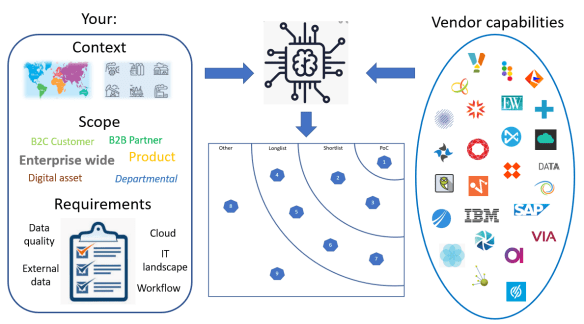
On this list there is no generic ranking. Instead there is a service where you can provide your organization’s context, scope and requirements and within 2 to 48 hours get your solution list.

The selection model includes these elements:

  • Your context in terms of geographical reach and industry sector.
  • Your scope in terms of domains to be covered and organizational scale stretching from specific departments over enterprise wide to business ecosystem wide (multi-enterprise).
  • Your specific requirements.
  • Vendor capabilities.
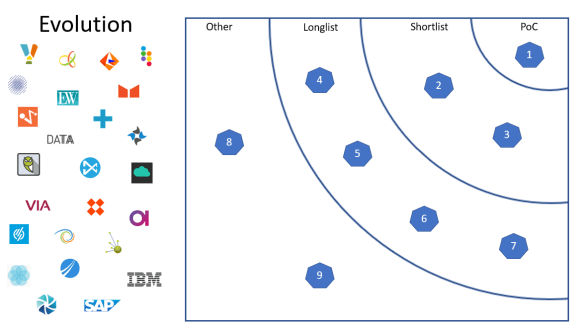
  • A model that combines those facts into a rectangle where you can choose to:
    • Go ahead with a Proof of Concept with the best fit vendor
    • Make an RFP with the best fit vendors in a shortlist
    • Examine a longlist of best fit vendors and other alternatives like combining more than one solution.

Selection Model

You can get your free solution list here.

Note that the solution vendors considered are those who are:

  • On this Disruptive MDM / PIM / DQM Solutions List or
  • Gartner MDM Magic Quadrant or
  • Forrester MDM Wave or Forrester PIM Wave or
  • Information Difference MDM Landscape

Evolutionary Solutions with Disruptive Impact on the MDM and Adjacent Markets

If you read The Latest Gartner MDM Magic Quadrant there is not so many clues about that the MDM market will undergo drastic changes.

Therefore, it is refreshing that Gartner analyst Malcolm Hawker has written a blog post called The Evolution of MDM. In here Malcolm Hawker examines the “evolutionary forces that are having disruptive impacts on the markets for MDM software and several adjacent markets”.

This include:

  • The growing use of graph and AI/ML
  • The increasing use of graph in big data environments for entity resolution
  • The idea that a gold master record could be created at ‘run time’
  • The explosive growth of MDM deployments in the cloud

A blog post about the future and a magic quadrant that primarily observes what happened a year or more ago at existing deployments at large organizations is, as Malcolm Hawker also indicates, of course two different things.

For organizations on the look for a platform covering MDM and/or the adjacent markets (CDP, PIM, PDS and more) the relevant vision, roadmap and approach at the vendors is crucial.

Use this list to get and overview of who has the innovative direction that fits your organization.

Evolutionary Solutions

This List and the Gartner MDM Magic Quadrant

There is a new Gartner Magic Quadrant for Master Data Management Solutions out. The Magic Quadrant is, besides a market overview, a generic ranking of solutions with a yearly license and maintenance revenue above 15 million USD.

This list (The Disruptive MDM/PIM/DQM List) is a list of registered solutions with a select your solution service based on your context, scope and requirements *). This list does besides MDM also cover the full range of Product Information Management (PIM) solutions and Data Quality Management (DQM) solutions as well.

Some innovative MDM solutions are both on the MDM magic quadrant and on this list. These are:

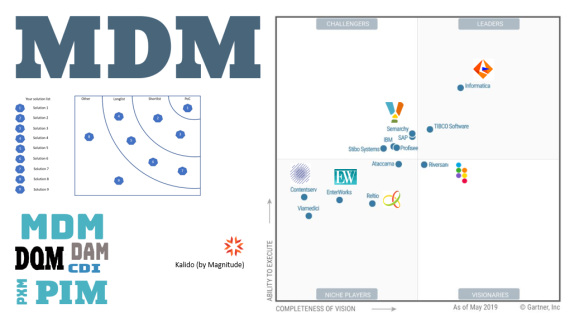
MDMlist and MDM MQ

*) All solutions on this list and in the magic quadrant are considered in the select your solution service.

What Will the Twenty-Twenties Bring to MDM?

We are now entering into a new decade: The twenty-twenties. Last time it was the twenties, back in the nineteen-twenties, this decade was defined as the Golden Age Twenties, the Roaring Twenties the Jazz Age or in French “Années folles” meaning the Crazy Years.

If we look into Master Data Management (MDM) the next decade could be the golden age of MDM. The MDM discipline has been around for 15 years or so now. The number of organizations that have implemented an MDM solution is not a big number – perhaps around 10,000 world-wide as examined in the post Counting MDM Licenses. This number may be more than 10-fold higher at the end of the decade and thus making MDM – and what is beyond – a common part of enterprise IT landscapes.

The next MDM decade will probably also be roaring, jazzy and even crazy. A lot is happening to MDM solutions and there are many questions to be answered about how the market will develop, as for example:

  • Will Customer Data Platforms(CDP) be part of CRM or MDM?
  • Will the MDM market and the Product Information Market (PIM) market be a big union or two separate markets?
  • Besides customer master data and product master data, which other master data, reference data and application data will commonly be included in MDM hubs?

You could also argue about if MDM will survive as a discipline!

What is your prediction about the next MDM decade?

MDM 20s