The Links Between MDM, PIM and Data Monetization

Data monetization is about harvesting direct financial results from having access to data that is stored, maintained, categorized and made accessible in an optimal manner. Traditionally data management & analytics has contributed indirectly to financial outcome by aiming at keeping data fit for purpose in the various business processes that produced value to the business. Today the best performers are using data much more directly to create new services and business models.

There are three ways of exploiting data monetization:

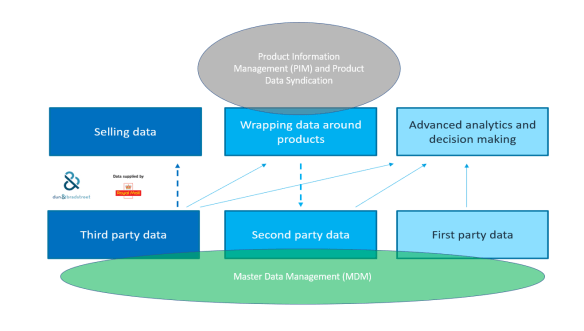
  • Selling data: This is something that have been known to the data management world for years. Notable examples are the likes of Dun & Bradstreet who is selling business directory data. Another example is postal services around the world selling their address directories. This is the kind of data we know as third party data.
  • Wrapping data around products: If you have a product – or a service – you can add tremendous value to these products and services and make them more sellable by wrapping data, potentially including third party data, around those products and services. These data will thus become second party at trading partners.
  • Advanced analytics and decision making: You can combine third party data, second party data and first party data (your own data) in order to make advanced analytics and fast operational decision making in order to sell more, reduce costs and mitigate risks.
Data Monetization MDM PIM

Master Data Management (MDM) is the core foundation for ensuring the multipurpose data quality of the data you sell, purchase from a third-party provider, push to trading partners, pull from trading partners and use in analytics and decision making. Product Information Management (PIM) is crucial when wrapping data around products and Product Data Syndication is essential when linking the data between trading partners.

On this site there is a list of forward-looking MDM, PIM and Product Data Syndication vendors who can enable your data monetization efforts. Find the list here.
MDM, PIM or Both

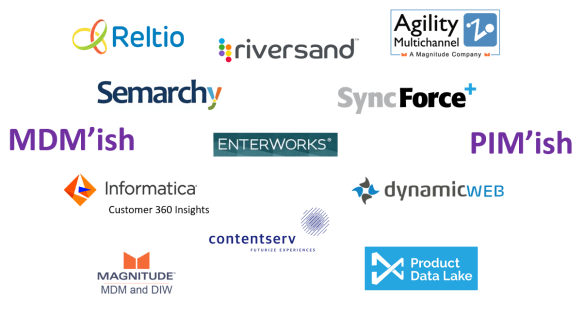
Organizations on the look for solutions that handles Master Data Management (MDM) and Product Information Management (PIM) have the choice of implementing a solution that is more focused on MDM, more focused on PIM or a solution (or mix of solutions) that encompasses both disciplines. Let us have a look at some of the solutions on the market that are either more MDM’ish, more PIM’ish or both:

MDM ish and PIM ish vendors 

Reltio is cloud based MDM’ish solution that also goes into other data types than traditional master data under a theme named modern data management. Learn more about Reltio Cloud here.

Semarchy is also MDM’ish and promoted as an intelligent data hub. Learn more about Semarchy xDM here.

Riversand has developed from being PIM’ish to now also being MDM’ish. Learn more about Riversand here.

EnterWorks has taken a similar route from being PIM’ish to being positioned as a MDM’ish solution too. Learn about Enterworks here.

CONTENTSERV is another example of a PIM’ish solution developing towards being MDM’ish too. Learn more about CONTENTSERV here.

SyncForce is a solution in the PIM’ish camp. Learn about SyncForce here.

Dynamicweb PIM is, as the name implies, another example of a PIM’ish solution. Learn more about Dynamicweb PIM here.

Informatica Customer 360 Insights is a MDM’ish solution from Informatica, who also delivers other MDM’ish and PIM’sih solutions. Learn more about Informatica Customer 360 Insights here.

Magnitude and Agility® are respectively an MDM’ish and a PIM’ish solution from the same house. Learn more about Magnitude MDM here and learn more about Agility here.

Product Data Lake is a PIM’ish solution that can supplement the other solutions in business ecosystem wide MDM. Learn more about Product Data Lake here

Multidomain MDM and the Next Big MDM Thing

Mutidomain MDM has been a trend in the Master Data Mamagement world for some years as told in the post Golden Records in Multidomain MDM.

Gartner, the analyst, firm, says in the latest MDM Magic Quadrant that “Several patterns have emerged whereby “customer,” “party,” “product” or “thing” master data have become the highest priority for a large number of organizations. The MDM solution should be capable of supporting all domains that are “in scope” for an MDM program, through either client-driven or prepackaged data model styles.”

Gartner has also together with the included vendors estimated the number of multidomain licenses sold on the market as seen in the post Counting MDM Licenses.

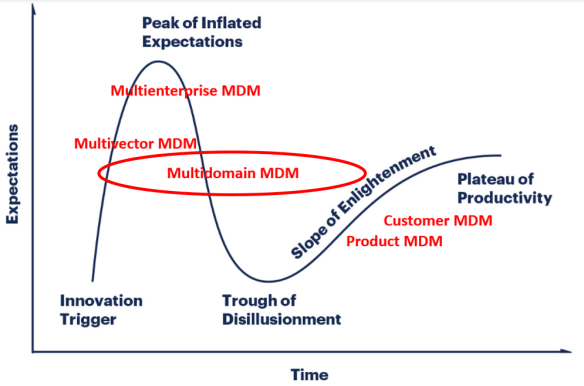
On the Hype Cycle for Information Management Gartner sees Multidomain MDM as sliding into the through of disillusionment while the customer and product single domains are at the slope of enlightenment.

Multidomain MDM Hype

Multiple domains are in the Gartner world one of several vectors of MDM. Other vectors are industries, usage scenarios (operational vs analytical), organizational structures (central vs local) and implementation styles (registry, consolidation, coexistence and centralized).

Another MDM theme that is trailing multidomain is multienterprise MDM – aka business ecosystem wide MDM.

Forrester, the other analyst firm, puts it this way in their latest MDM Wave: “As first-generation MDM technologies become outdated and less effective, improved second generation and third-generation features will dictate which providers lead the pack. Vendors that can provide internet-of-things (IoT) capabilities, ecosystem capabilities, and data context position themselves to successfully deliver added business value to their customers.”

What do you think: Will multidomain MDM prevail? Either way, what will be the next big thing(s)?

MDM, PIM, DAM within Data Management

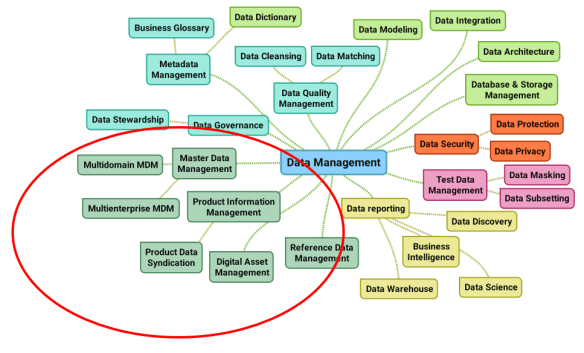
Master Data Management (MDM), Product Information Management (PIM) and Digital Asset Management (DAM) are some interrelated disciplines that again is interrelated with other disciplines in the data management space.

MDM PIM DAM and Data Management

The core disciplines are:

  • MDM has some sub disciplines, most notable:
    • Multidomain MDM which is when the MDM effort encompasses not only a single master data domain as for example customer, supplier, employee (all being party master data) or product master data but all master data domains relevant for a given organization.
    • Multienterprise MDM which is an emerging discipline where the scope of sharing master data goes from doing that within a given organization to embracing the business ecosystem(s) where the organization operates.
  • PIM can be seen as an extension to product master data management which takes care of the product information in marketing and sales scenarios. In addition:
    • PIM has some overlapping acronyms as PCM, PDM, PLM and PxM as discussed in the post Product Something Management.
    • Product Data Syndication is the multienterprise (business ecosystem wide) scenario related to PIM, where product information is shared between trading partners (or between disconnected entities belonging to the same organization).
  • DAM is most commonly related to PIM and the requirement for handling digital assets as images, textual documents, videos and more related to products, but the digital assets can also relate to other master data entities.

Reference Data Management (RDM) is closely related to these disciplines as told in the post RDM: A Small but Important Extension to MDM.

Data Governance can be seen as an overarching discipline for data management and should also go hand in hand with MDM, PIM and DAM. A core result from MDM, PIM and DAM activities is to provide sustainable data quality so that data cleansing and data matching does not have to be done over and again.

MDM and RDM underpins data reporting activities, Test Data Management (TDM) and data security and MDM, PIM and DAM is an essential aspect of data architecture, data modelling and data integration.

If you are considering solutions for MDM, PIM and DAM, our list features some of the best solutions from the most forward-looking vendors on the market. Check it out here.

MDM versus ADM

The term Application Data Management (ADM) has been circulating in the Master Data Management (MDM) world for some time as touched in the post MDM Fact or Fiction: Who Knows?

Not at least Gartner, the analyst firm, has touted this as one of two Disruptive Forces in MDM Land. The two terms MDM and ADM relates as seen below:

ADM MDM.png

So, ADM takes care of a lot of data that both is master data but also data that we do not usually consider being master data within a given application while MDM takes care of master data across multiple applications.

The big question is how we handle the intersection (and sum of intersections in the IT landscape) when it comes to applying technology.

If you have an IT landscape with a dominant application like for example SAP ECC you are tempted to handle the master data within that application as your master data hub or using a vendor provided tightly integrated tool as for example SAP MDG. For specific master data domains, you might for example regard your CRM application as your customer master data hub. Here MDM and ADM melts into one process and technology platform.

If you have an IT landscape with multiple applications, you could consider implementing a specific MDM platform that receives master data from and provides master data to applications that takes care of all the other data used for specific business objectives. Here MDM and ADM will be in separated processes using best-of-breed technology.

Finally we also see platforms that previously were branded as MDM platforms but now evolves into general data management platforms covering more than just master data.