
The term golden record is a core concept within Master Data Management (MDM) and Data Quality Management (DQM). A golden record is a representation of a real world entity. This representation may be compiled from multiple different representations of that entity in a single or in multiple different databases within the enterprise system landscape.
A golden record is optimized towards meeting data quality dimensions as:
- Being a unique representation of the real world entity described
- Having a complete description of that entity covering all purposes of use in the enterprise
- Holding the most current and accurate data values for the entity described
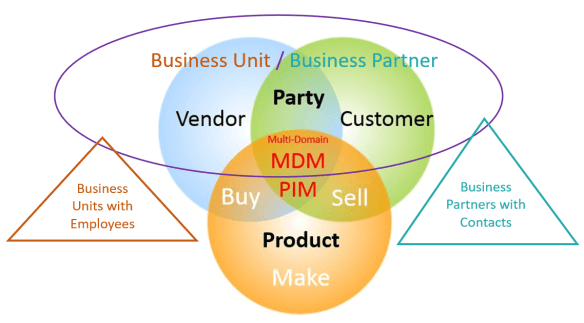
In Multidomain MDM we work with a range of different entity types as party (with customer, supplier, employee and other roles), location, product and asset. The golden record concept applies to all of these entity types, but in slightly different ways.
Party Golden Record
Having a golden record that facilitates a single view of a customer is probably the most known example of using the golden record concept. Managing customer records and dealing with duplicates of those is the most frequent data quality issue around.
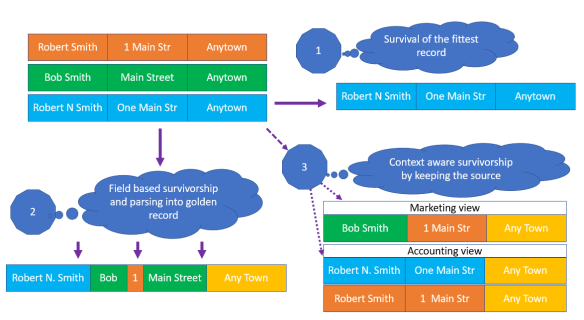
If you are not able to prevent duplicate records from entering your MDM world, which is the best approach, then you have to apply data matching capabilities. When identifying a duplicate you must be able to intelligently merge any conflicting views into a golden record as examined in the post Three Master Data Survivorship Approaches.
In lesser degree we see the same challenges in getting a single view of suppliers and you ultimately will want to have a single view on any business partner, also where the same real world entity have both customer, supplier and other roles to your organization.
There are party identification systems available. Most countries have national ID systems for both citizens (however in most countries mostly restricted to public administration) and organizations. There is Legal Entity Identifier (LEI) concept slowly penetrating in financial services. Also, there are commercial organization identifiers as the Duns Number available.
Location Golden Record
Having the same location only represented once in a golden record and applying any party, product and asset record, and ultimately golden record, to that record may be seen as quite academic. Nevertheless, striving for that concept will solve many data quality conundrums.
Location management have different meanings and importance for different industries. One example is that a brewery makes business with the legal entity (party) that owns a bar, café, restaurant. However, even though the owner of that place changes, which happens a lot, the brewery is still interested in being the brand served at that place. Also, the brewery wants to keep records of logistics around that place and the historic volumes delivered to that place. Utility and insurance are other examples of industries where the location golden record (should) matter a lot.
Knowing the properties of a location also supports the party deduplication process. For example, if you have two records with the name “John Smith” on the same address, the probability of that John Smith being the same real world entity is dependent on whether that location is a single-family house or a nursing home.
Location identification concepts revolves around postal adresses, which are fluffy and varies in format by country, and geocoding systems as latitude/longitude, UTM coordinates, WGS coordinates and more.

Product Golden Record
Product Information Management (PIM) solutions became popular with the raise of multi-channel where having the same representation of a product in offline and online channels is essential. The self-service approach in online sales also drew the requirements of managing a lot more product attributes than seen before, which again points to a solution of handling the product entity centralized.
In large organizations that have many business units around the world you struggle with having a local view and a global view of products. A given product may be a finished product to one unit but a raw material to another unit. Even a global SAP rollout will usually not clarify this – rather the contrary.
While third party reference data helps a lot with handling golden records for party and location, this is lesser the case for product master data. Classification systems and data pools do exist, but will certainly not take you all the way. With product master data you must rely more on second party master data meaning sharing product master data within the business ecosystems where you operate.
The none-profit organization GS1 has done a lot in implementing the Global Trade Item Number (GTIN) based on the Universal Product Code (UPC) and the European Article Number (EAN) concept. However there are still some challenges in this concept around packaging levels and more.
Asset (or Thing) Golden Record
In asset master data management you also have different purposes where having a single view of a real world asset helps a lot. There are namely financial purposes and logistic purposes that have to aligned, but also a lot of others purposes depending on the industry and the type of asset.
With the raise of the Internet of Things (IoT) we will have to manage a lot more assets (or things) than we usually have considered. When a thing (a machine, a vehicle, an appliance) becomes intelligent and now produces big data, master data management and indeed multi-domain master data management becomes imperative.
You will want to know a lot about the product model of the thing in order to make sense of the produced big data. For that, you need the product (model) golden record. You will want to have deep knowledge of the location in time of the thing. You cannot do that without the location golden records. You will want to know the different party roles in time related to the thing. The owner, the operator, the maintainer. If you want to avoid chaos, you need party golden records.
Tools That Can Help
This site has a list of innovative MDM and DQM solution that can help you mastering golden records. Check out the list here.

 Have you ever wondered how to effectively evaluate the return on investment (ROI) of a Product Information Management (PIM) and Master Data Management (MDM) implementation? Then, take a look at some real-life examples. Download the

 MDM solutions have been instrumental in solving core data quality issues in a traditional way, focusing primarily on simple master data entities such as customer or product. Organizations now face new challenges with broader and deeper data requirements to succeed in their digital transformation. Help your organization through a successful digital transformation while taking your MDM initiative to the next level. Download the
  Businesses today face a rapidly growing mountain of content and data. Mastering this content can unlock a whole new level of Business Intelligence for your organization and impact a range of data analytics. It’s also crucial for operational excellence and digital transformation. Download the 1WorldSync and

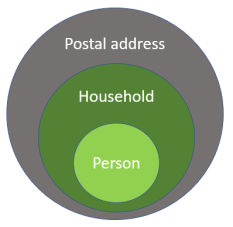 With persons in private roles a classic challenge is to distinguish between the individual person, a household with a shared economy and people who happen to live at the same postal address. The location hierarchy plays a role in solving this case. This quest includes having precise addresses when identifying units in large buildings and knowing the kind of building. The probability of two John Smith records being the same person differs if it is a single-family house address or the address of a nursing home.
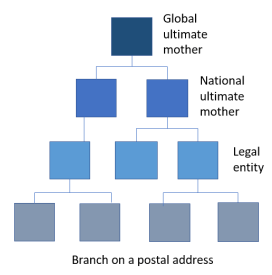 Organizations can belong to a company family tree. A basic representation for example used in the Dun & Bradstreet Worldbase is having branches at a postal address. These branches belong a legal entity with a headquarter at a given postal address, where there may be other individual branches too. Each legal entity in an enterprise may have a national ultimate mother. In multinational enterprises, there is a global ultimate mother. Public organizations have similar often very complex trees.
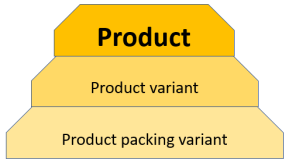 Products are also formed in hierarchies. The challenge is to identify if a given product record points to a certain level in the bottom part of a given product hierarchy. Products can have variants in size, colour and more. A product can be packed in different ways. The most prominent product identifier is the Global Trade Identification Number (GTIN) which occur in various representations as for example the Universal Product Code (UPC) popular in Orth America and European (now International) Article Number (EAN) popular in Europe. These identifiers are applied by each producer at the product packing variant level.
 The Disruptive MDM / PIM / DQM List