September 2019 Achievements

September 2019 has in many ways been a record month for this list.

The number of visitors has doubled compared to last month and increased three times compared to last year’s average – and so have the page views.

Number of LinkedIn page followers has increased 27 % since last month.

The new Select your solution service has got a good debut with 16 requests for a tailored list of solutions fit for your context, scope and requirements.

A new solution has entered the list: Check out Reifier here.

MDMlist stats 2019 09

Thanks to all visitors, followers, solution selectors and registrants.


Five Essential MDM / PIM Capabilities

Many of the recent posts here on the blog have been around some of the most essential capabilities that Master Data Management (MDM) and Product Information Management (PIM) solutions are able to provide.

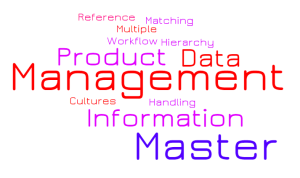
Five MDM PIM CapabilitiesData Matching

Having the ability to match and link master data records that are describing the same real-world entity is probably most useful in MDM and in the context of party master data. However, there are certainly also scenarios where product master data must be matched. While identifying the duplicates is hard enough, there must also be functionality to properly settle the match as explained in the post Three Master Data Survivorship Approaches.

Workflow Management

While the first MDM / PIM solutions emphasized on storing “a single source of truth” for master data, most tools today also provide functionality for processing master data. This is offered through integrated workflows as examined in the post Master Data Workflow Management.

Hierarchy Management

Master data comes in hierarchies (and even graphs). Examples are company family trees, locations and product classifications as told in the post Hierarchy Management in MDM and PIM.

Handling Multiple Cultures

If your solution will be implemented across multiple countries – and even in countries with multiple languages – you must be able to manage versions of master data and product information in these languages and often also represented in multiple alphabets and script systems. This challenge is described in the post Multi-Cultural Capabilities in MDM, PIM and Data Quality Management.

Reference Data Management

The terms master data and reference data are sometimes used synonymously. The post What is Reference Data Management (RDM)? is about what is usually considered special about reference data. Some MDM (and PIM) solutions also encompasses the handling of reference data.

The Capabilities That You Need

The above-mentioned capabilities are just some of the requirements you can mark in a service that can draft a list of MDM/PIM/DQM tools that are most relevant for you. Try it here: Select your solution.

DQM Tools In and Around MDM Tools

Data Quality Management (DQM) and Master Data Management (MDM) are overlapping disciplines within data management. An obvious reason for this overlap is that most data quality challenges are found in master data. Prominent examples are duplicates in customer master data, inaccurate location master data and incomplete product information.

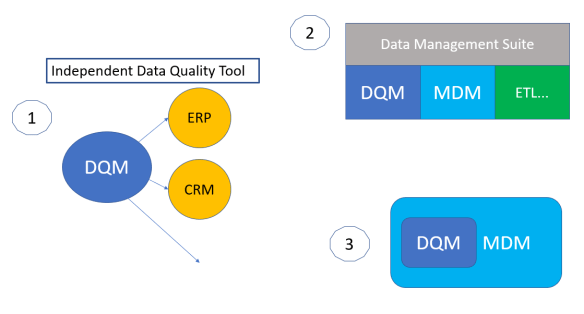
In this spectrum we have three kinds of tools on the market:

  1. Independent data quality tools that are mainly emphasizing on these capabilities:
    • Data matching with the aim of identifying duplicates and making a link between two or more data records that describes the same real-world entity.
    • Data profiling with the aim of identifying and quantifying data quality issues as anomalies, inconsistency and incompleteness.
  2. Data quality tools offered under the same brand and packaged together with MDM tools and other data management tools in a data management suite.
  3. Data quality capabilities as data matching and data profiling built into (extended) MDM platforms.

The results (golden records) from independent data quality tools can be stored and maintained in the master data part of business applications as ERP and CRM systems – or a separate MDM platform.

DQM in and around MDM

The ability to settle a more complex result of for example deduplication, as explained in the post Three Master Data Survivorship Approaches, can drive the requirement of which of the above-mentioned tools that will serve your organization best.

This list welcomes all the mentioned DQM offerings. Check out the current list here.

What is Reference Data Management (RDM)?

One of the specialized data management solution types encompassed by this Disruptive MDM / PIM / DQM List is Reference Data Management (RDM).

Reference data are typically smaller lists of data records that are referenced by master data and transaction data. These lists do not change often. They tend to be externally defined but can also be internally defined within each organization. The below table have some examples of reference data lists used across many organizations and industries:Reference DataRDM solutions may offer this functionality around the reference data:

  • The data store that holds the data
  • The user interface for maintaining the lists
  • Access control
  • Hierarchy management as for example how countries have (or not have) states/provinces that have postal codes
  • Managing relationships and mapping between the list values as for example how a SIC industry sector code relates to NACE industry sector codes
  • Versioning of the lists
  • Language and further context management
  • Audit trails
  • Approval workflows
  • Data integration capabilities

There are applications that is purely focussing on RDM as well as MDM and broader data management solutions / suites that have RDM as a one of several capabilities where the above-mentioned functionality is shared with master data and perhaps other critical application data.

If you use the select your solution service here on the site, RDM is one of the capabilities you can mark as a requirement for your solution.

Interview with FX Nicolas, VP of Products at Semarchy

This site is a presentation of the best available Master Data Management (MDM), Product Information Management (PIM) and Data Quality Management (DQM) solutions. However, behind the technology there are people who is working hard to bring the best tools to live, break into the market and cover new land.

Semarchy was one of the first disruptive MDM solutions to join the list and FX was one of the first employees to join Semarchy.

FX NicolasFX, what was your path into Master Data Management?

It started with Data Integration. Back in 2000, we designed a data integration product called “Sunopsis”. It was the first solution to use an E-LT architecture. In fact, we created that acronym as a “smart data geek” joke, and it is now an established marketing buzzword. The product was acquired by Oracle and is still on the market under the Oracle Data Integrator name. I was Product Manager for Sunopsis and Oracle Data Integrator. As such I was exposed to the challenges of integration (real-time vs. batch, EAI vs. ETL, data quality, performance, etc.). Governance and MDM were not yet trendy terms, but we had the idea of a technical “Active Data Hub”, managed at the integration layer, to share high quality data between systems.

Semarchy was founded in 2011. How did the MDM market look like then?

A vast plain with two large circles of massive monoliths, namely the Customer Data Hub (CDH) and Product Information Management (PIM) verticals. Some of them were ironically sold by the same vendors who had failed to properly manage customer and product data in operational systems (CRMs, ERPs, etc.). When we looked at the market, we realized that there was room for domain-agnostic platforms to support customer, product, and every other domain.

The market was also a graveyard of failed projects. The reasons why so many projects ended up there were suspected (gigantic project scopes with insanely large timeframes, lack of agility and business involvement, etc.) but never clearly stated.

You have been in the forefront of introducing Semarchy. What have been the most difficult challenges in breaking into the market?

Building the platform was a challenge, but education was the hardest part. When you tell people that you know why they have failed or will fail, and you have a solution for a better outcome, they are not really willing to listen. We had to educate people with sound messages: “Yes sir, data quality is part of master data management”, “Start small and grow your initiative”, “Involve the business all along”.

Another challenge was the multiple number of shiny new trends and buzzwords popping up in the data space. Big data, cloud, graph, digital transformation, and now AI? Pick your favorite! Data management, governance, quality or workflows look very dull in comparison. The good thing is good practitioners know that these are prerequisites to get things done correctly.

Now that Semarchy has become an established player on the MDM market, what is the next move?

Since our inception, we’ve always believed in a single platform to solve all master data management issues. This all-in-one solution is still a dream for most companies, who struggle with four or five tools to manage their data. We are now ahead of that with our next move: extending our platform to be the end-to-end Intelligent Data Hub™. This includes new capabilities such as:

  • Data Discovery: Profiling data sources and learning about existing critical data assets.
  • Integration of any applications and leveraging any data source or service to enhance the enterprise data.
  • Governing the data hub by defining and enforcing business terms, processes, rules, policies, etc.
  • Managing data using apps designed for data champions and business users, with built-in data quality, match and merge, workflows, generated from the governance definitions and decisions.
  • Measuring the efficiency of the operations and the relevance of the governance choices using dashboards, KPIs and metrics based on data from the data hub or from external data sources.

Can you tell something more about how the Intelligent Data Hub is extending the MDM concept?

MDM is mainly about managing the domains core data assets (reference, customer, product, etc..) with data quality, match/merge and stewardship workflows. The data hub extends this idea in multiple directions:

  • It extends the scope of data available via the data hub beyond core master data, for example by eventually including transactional data and interactions to provide 360° views.
  • It takes an end-to-end approach for the data management initiative: from data governance, data onboarding with data discovery, profiling and cataloguing, down to the assessment of the value delivered with dashboards and KPIs.
  • It transparently opens the initiative to the whole enterprise. All business users become full members of the initiative via the data governance, data management and measurement channels. In short, the Intelligent Data Hub transforms every stakeholder in the organization into a data champion.

If you should have done something differently in Semarchy’s route to where you are now, what would that have been?

Go to the cloud from the beginning! Our platform is now available on major cloud platforms. If I had to do it again, I would have shipped the first version on premises *and* in the cloud.