It Is Black Friday and Cyber Monday All the Time at the List

The upcoming Black Friday and Cyber Monday are synonymous with good deals.

At the Disruptive MDM / PIM / DQM List there are good deals all the days.

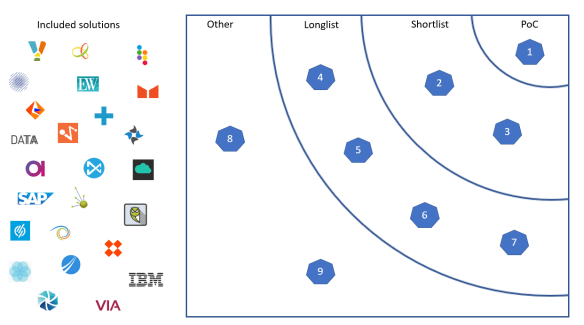
As a potential buyer on the look for a solution covering your Master Data Management (MDM), Product Information Management (PIM) and/or Data Quality Management (DQM) needs you can use the free service that based on your context, scope and requirement selects the best fit solution(s). You can start here.

Black Friday

As a solution provider you can against a very modest fee register your solution here.

Happy Black Friday and Cyber Monday.

The 10 Data Management TLAs on This List

TLA stands for Three Letter Acronym. The world is full of TLAs. The IT world is full of TLAs. The Data Management world is full of TLAs. Here are the 10 TLAs from the data management world that covers the solutions encompassed on this list:

  • MDM = Master Data Management can be defined as a comprehensive method of enabling an enterprise to link all of its critical data to a common point of reference. When properly done, MDM improves data quality, while streamlining data sharing across personnel and departments. In addition, MDM can facilitate computing in multiple system architectures, platforms and applications. You can find the source of this definition and 3 other – somewhat similar – definitions in the post 4 MDM Definitions: Which One is the Best?
  • PIM = Product Information Management is a discipline that overlaps MDM. In PIM you focus on product master data and a long tail of specific product information related to each given classification of products. This data is used in omni-channel scenarios to ensure that the products you sell are presented with consistent, complete and accurate data. Learn more in the post Five Product Information Management Core Aspects.
  • DAM = Digital Asset Management is about handling rich media files often related to master data and especially product information. The digital assets can be photos of people and places, product images, line drawings, brochures, videos and much more. You can learn more about how these first 3 mentioned TLAs are connected in the post How MDM, PIM and DAM Stick Together.
  • DQM = Data Quality Management is dealing with assessing and improving the quality of data in order to make your business more competitive. It is about making data fit for the intended (multiple) purpose(s) of use which most often is best to achieved by real-world alignment. It is about people, processes and technology. When it comes to technology there are different implementations as told in the post DQM Tools In and Around MDM Tools.
  • RDM = Reference Data Management encompass those typically smaller lists of data records that are referenced by master data and transaction data. These lists do not change often. They tend to be externally defined but can also be internally defined within each organization. Learn more in the post What is Reference Data Management (RDM)?
  • 10 TLA showCDI = Customer Data Integration, which is considered as the predecessor to MDM, as the first MDMish solutions focussed on federating customer master data handled in multiple applications across the IT landscape within an enterprise. You may ask: What Happened to CDI?
  • CDP = Customer Data Platform is an emerging kind of solution that provides a centralized registry of all data related to parties regarded as (prospective) customers at an enterprise. Right now, we see such solutions coming both from MDM solution vendors and CRM vendors as reported in the post CDP: Is that part of CRM or MDM?
  • ADM = Application Data Management, which is about not just master data, but all critical data however limited to a single (suite of) application(s) at the time. ADM is an emerging term and we still do not have a well-defined market as examined in the post Who are the ADM Solution Providers?
  • PXM = Product eXperience Management is another emerging term that describes a trend to distance some PIM solutions from the MDM flavour and more towards digital experience / customer experience themes. Read more about it in the post What is PxM?
  • PDS = Product Data Syndication, which connects MDM, PIM (and other) solutions at each trading partner with each other within business ecosystems. As this is an area where we can expect future growth along with the digital transformation theme, you can get the details in the post What is Product Data Syndication (PDS)?

How to Select Your MDM / PIM / DQM Solution

The solution selection service on this site has been up and running for nearly two months now.

This service is unique because:

  • It is an individual list based on your context, scope and requirements.
  • It is near real-time:
    • You fill in your information here on the site. On average previous requesters spent 15 minutes to do so.
    • You will get the report back quickly. On average previous requesters have received the report within 12 hours.

The solutions considered are those who are:

You can try the free service here: Select your solution.

Select your solution 20191103

September 2019 Achievements

September 2019 has in many ways been a record month for this list.

The number of visitors has doubled compared to last month and increased three times compared to last year’s average – and so have the page views.

Number of LinkedIn page followers has increased 27 % since last month.

The new Select your solution service has got a good debut with 16 requests for a tailored list of solutions fit for your context, scope and requirements.

A new solution has entered the list: Check out Reifier here.

MDMlist stats 2019 09

Thanks to all visitors, followers, solution selectors and registrants.


DQM Tools In and Around MDM Tools

Data Quality Management (DQM) and Master Data Management (MDM) are overlapping disciplines within data management. An obvious reason for this overlap is that most data quality challenges are found in master data. Prominent examples are duplicates in customer master data, inaccurate location master data and incomplete product information.

In this spectrum we have three kinds of tools on the market:

  1. Independent data quality tools that are mainly emphasizing on these capabilities:
    • Data matching with the aim of identifying duplicates and making a link between two or more data records that describes the same real-world entity.
    • Data profiling with the aim of identifying and quantifying data quality issues as anomalies, inconsistency and incompleteness.
  2. Data quality tools offered under the same brand and packaged together with MDM tools and other data management tools in a data management suite.
  3. Data quality capabilities as data matching and data profiling built into (extended) MDM platforms.

The results (golden records) from independent data quality tools can be stored and maintained in the master data part of business applications as ERP and CRM systems – or a separate MDM platform.
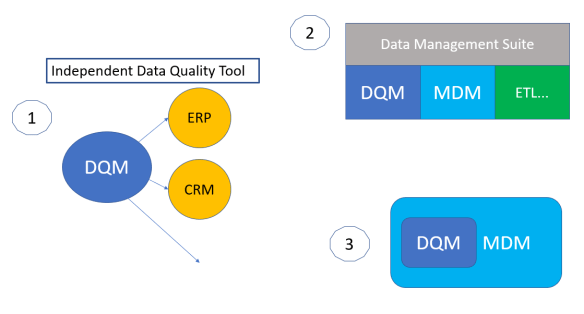
DQM in and around MDM

The ability to settle a more complex result of for example deduplication, as explained in the post Three Master Data Survivorship Approaches, can drive the requirement of which of the above-mentioned tools that will serve your organization best.

This list welcomes all the mentioned DQM offerings. Check out the current list here.