Why next generation MDM and PIM solutions must be in the Cloud

In this guest blog post Shamanth Shankar of Riversand explains why the next generation of Master Data Management (MDM) and Product Information Management (PIM) solutions must be deployed as cloud solutions.

As retailers grow, managing data across their application landscape becomes crucial. Business users and Information Technology (IT) leaders want to choose data management solutions that provide insights to them and provide relevant information to their customers along their purchasing life-cycle. Accommodating scale, speed and different data types requires that data management solutions evolve.

How are enterprises coping with scale and flexibility?

Enterprise software solutions are going through a revolution to accommodate scale and flexibility. Looking at the growth of AWS and Azure, one can imagine how aggressively enterprises are embracing cloud. AWS grew 54.9% year on year and Microsoft’s Azure grew  triple digits over the last five quarters. Cloud is growing at a 22% Compound Annual Growth Rate (CAGR), four times the rate of software spending growth. Flexibility in operating models (Operational Expense vs. Capital Expense), ease of implementation and cost savings lure business leaders towards the cloud. To strike a balance with the legacy of on premise solutions and cloud-based business friendly applications, enterprises will pursue a hybrid cloud model.

Cloud and Retailers

Compared to other verticals, retail has a lower barrier to adopting cloud. Cloud is expected to grow five-fold in retailing. Additional data points supporting this continued accelerated growth of cloud-based solutions, include;

  • Digital commerce platforms are growing at 15% CAGR, driven by SaaS revenues.
  • Non-Store retailers reported 12% year on year growth per the US Department of Commerce.

Retailers invest in various hybrid cloud-based solutions throughout their enterprise to providetheir consumers with personalized attention, constant engagement and better experiences.The central focus of this effort is to provide business users with a better user experience along with consistent data (especially product data) all with the goal of creating great experiences for consumers.

Product Information Management Solution

Synchronization of product data across applications and channels is critical to enterprises for improved efficiencies, faster new product introduction and higher sales. A Product Information Management (PIM) solution provides a single source of truth, high quality product content, global product taxonomies, aggregation and syndication with internal and external sources.

PIM solutions improve sales by providing the right product for the right customer at the right time, improve efficiencies by accelerating new product introduction, reduce supply chain costs and identify bottlenecks through better reporting. By connecting with data pools, vendor data, marketplaces, e-commerce platforms and Digital Asset Management solutions, PIM solutions connect to the entire application ecosystem and keep all the business users on the same page with “Trusted Product Data”. The foundation of this “Trusted Product Data” drives an enterprise towards data-driven and outcome based operations. In such an ecosystem, data models are defined, product data is mapped to marketplace structures, outcomes are measured and changes are accommodated on a periodic basis.

Transformation in Product Information Management

As retailers grow (organically or through acquisition), data models need to be changed, infrastructure needs to be expanded and global variations need to be consolidated into one solution. In addition to strategic topline growth, changing consumer choices, interactions and sentiments force business transformations.

Business leaders and IT leaders want to gain insights from their PIM solution and ensure they are providing relevant information to their customers. They expect a PIM solution to help them solve the following:

Assortment and Product Intelligence

Can they match the relevant assortment and products to the respective consumer segments, and understand  particular consumer’s sentiments?

Channel and Operational Intelligence

 How are the products performing on various channels and what impact does product data quality have on supply chain costs?

Competitive Intelligence

Does the competition differ by merchandising category?
How is the merchandise performing compared to the competition?

Both business and IT users are looking to accommodate this inward-looking information into their application ecosystem.

IT teams are finding it challenging to correlate external data with their internal data management practices. They are looking for cost effective technologies that can provide insights into underperforming product segments.

Merchandising teams curating product content have limited to nonexistent abilities to map or correlate product content to consumer segments, competitors, or sentiment via social channels.

Customer service teams are trying to analyze and draw insights from consumer and market segment analysis and marry them with category specific context.

Next Generation Solution

Current data management solutions need to evolve to manage increasing master data  and related expanding data pools at scale. These solutions will have to be based on hybrid technology frameworks involving SQL, NoSQL, Graph and persist both structured and unstructured data. To provide higher Return on Investment and lower Total Cost of Ownership to retailers, such solutions will need to be able to scale in or out with a pay-as-you-go model. Considering that enterprises will continue supporting on premise, private cloud and public cloud models, PIM solutions must provide all these capabilities both on premise and in the cloud.

Next Generation data management will bring global business complexities together into a single solution that is web-scale, dynamically configurable and offers the best user experience for both business and IT teams.

Shamanth Shankar supports business operations at Riversand. Till recently Shamanth led Marketing at Riversand. Prior to Riversand Shamanth consulted clients on Data & Analytics products, led S&OP at a manufacturing company and managed a Product Line at a public company. Shamanth holds degrees from Rice, Texa A&M and IIT Madras.

industry and Internet of Things concept. woman working in factory and wireless communication network. Industry4.0.

4 Vendor Paths to Multidomain MDM

In short, multidomain Master Data Management (MDM) is about handling all core business entities under a single regime. This encompasses customer MDM, vendor MDM – or better unified party / business partner MDM, product MDM, location MDM, asset MDM and the relations between those domains.

MDM VennAs a user organization you may choose the buy these technologies separately or buy a multidomain MDM solution from a given vendor.
There are a range of available multidomain solutions on the market. These solutions have been assembled in different ways. Below are 4 paths various vendors have taken to offer a multidomain MDM solution:

Acquisition

Mega-vendors as IBM, Oracle and Informatica have bought best-of-breed solutions and wrapped those under the brand. Taking advantage of this offering will typically mean also choosing other technologies from there whole application stack and the technologies that handles the various domains will not be exactly the same.

ADM

ADM stands for Application Data Management. Some offerings are an extension to an ERP suite. The predominant example is SAP MDG. With SAP MDG you get a close integration and a data model fit with the popular SAP ECC solution. However, if you want to include other sources, you may have a hard time doing that.

PIM

Some former traditional Product Information Management (PIM) vendors have successfully transformed their solution into a true multidomain MDM solution. This includes (all from this list) Enterworks, Riversand and Stibo Systems. Recently Stibo Systems announced that their last year’s impressive growth was led by increased demand for multidomain solutions.

Natural born

Other solutions are built up from scratch and thought through as a multidomain MDM solution. Examples includes Orchestra Networks, Reltio and Semarchy.

8 Forms of Master Data Management

8 forms MDM

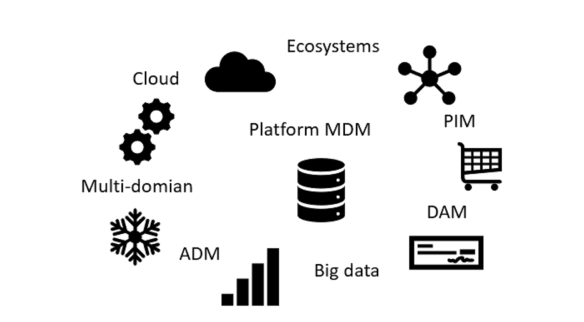
Master Data Management (MDM) can take many forms. In the following I will shortly introduce 8 forms of MDM. A given MDM implementation will typically be focused on one of these forms with some elements of the other forms and a given piece of technology will have an origin in one of these forms and in more or less degree encompass some more forms:

1.      The traditional MDM platform: A traditional MDM solution is a hub for master data aiming at delivering a single source of truth (or trust) for master data within a given organization either enterprise wide or within a portion of an enterprise. The first MDM solutions were aimed at Customer Data Integration (CDI), because having multiple and inconsistent data stores for customer data with varying data quality is a well-known pain point almost everywhere. Besides that, similar pain points exist around vendor data and other party roles, product data, assets, locations and other master data domains and dedicated solutions for that are available.

2.      Product Information Management (PIM): Special breed of solutions for Product Information Management aimed at having consistent product specifications across the enterprise to be published in multiple sales channels have been around for years and we have seen a continuously integration of the market for such solutions into the traditional MDM space as many of these solutions have morphed into being a kind of MDM solution.

3.      Digital Asset Management (DAM): Not at least in relation to PIM we have a distinct discipline around handling digital assets as text documents, audio files, video and other rich media data that are different from the structured and granular data we can manage in data models in common database technologies. A post on this blog examines How MDM, PIM and DAM Stick Together.

4.      Big Data Integration: The rise of big data is having a considerable influence on how MDM solutions will look like in the future. You may handle big data directly inside MDM og link to big data outside MDM as told in the post about The Intersection of MDM and Big Data.

5.      Application Data Management (ADM): Another area where you have to decide where master data stops and handling other data starts is when it comes to transactional data and other forms data handled in dedicated applications as ERP, CRM, PLM (Product Lifecycle Management) and plenty of other industry specific applications. This conundrum was touched in a recent post called MDM vs ADM.

6.      Multi-Domain MDM: Many MDM implementations focus on a single master data domain as customer, vendor or product or you see MDM programs that have a multi-domain vision, overall project management but quite separate tracks for each domain. We have though seen many technology vendors preparing for the multi-domain future.

7.      MDM in the cloud: MDM follows the source applications up into the cloud. New MDM solutions naturally come as a cloud solution. The traditional vendors introduce cloud alternatives to or based on their proven on-promise solutions. There is only one direction here: More and more cloud MDM – also as customer as business partner engagement will take place in the cloud.

8.      Ecosystem wide MDM: Doing MDM enterprise wide is hard enough. But it does not stop there. Increasingly every organization will be an integrated part of a business ecosystem where collaboration with business partners will be a part of digitalization and thus we will have a need for working on the same foundation (doing Multienterprise MDM as Gartner coins it) as reported in the post Ecosystem Wide MDM.

PS: If you are a vendor on the MDM, PIM or DAM market you can promote your solution here on the list and emphasize on the forms you support. Registration can be done here.

MDM Fact or Fiction: Who Knows?

Over at the IRM connects blog Aaron Zornes wrote about MDM & Data Governance Market 2018-19: Facts vs. Beliefs.

It is always fun to be entertained by analysts bashing each other and Aaron Zornes makes no exception in his blog post when pointing out that it took Gartner 12 years to realize that there are not two MDM markets anymore (Customer MDM / CDI vs Product MDM /PIM) but only one.

Also, the recent vitalized notion of Application Data Management (ADM) by Gartner gets a few words about who is lagging and who is leading in market analysis.

Else the two entertaining trends the coming years will according to Aaron Zornes be Graph databases and machine learning.

MDM ADMSo, a lot of questions for buyers and vendors are piling up:

  • Should your solution be multi-domain MDM or will there still be room for specialized CDI (Customer Data Integration) and PIM (Product Information Management) solutions?
  • Does ADM (Application Data Management) solutions, meaning building your master data capabilities inside ERP, CRM and so make sense?
  • Will graph databases really brake through in MDM soon?
  • Can ML (Machine Learning) help delivering business benefits in MDM – and when will that happen?

As the analysts disagree between each other, you can have your say here on the list by commenting on this blog post, under the registered solutions or as a not yet listed vendor registering your disruptive solution.

How MDM Solutions are Changing

When Gartner, the analyst firm, today evaluates MDM solutions they measure their strengths within these use cases:

  • MDM of B2C Customer Data, which is about handling master data related to individuals within households acting as buyers (and users) of the products offered by an organisation
  • MDM of B2B Customer Data, which is about handling master data related to other organizations acting as buyers (and users) of the products offered by an organisation.
  • MDM of Buy-Side Product Data, which is about handling product master data as they are received from other organisations.
  • MDM of Sell-Side Product Data, which is about handling product master data as they are provided to other organisations and individuals.
  • Multidomain MDM, where all the above master data are handled in conjunction with other party roles than customer (eg supplier) and further core objects as locations, assets and more.
  • Multivector MDM, where Gartner adds industries, scenarios, structures and styles to the lingo.

QuadrantThe core party and product picture could look like examined in the post An Alternative Multi-Domain MDM Quadrant. Compared to the Gartner Magic Quadrant lingo (and the underlying critical capabilities) this picture is different because:

  • The distinction between B2B and B2C in customer MDM is diminishing and does not today make any significant differentiation between the solutions on the market.
  • Handling customer as one of several party roles will be the norm as told in the post Gravitational Waves in the MDM World.
  • We need (at least) one good MDMish solution to connect the buy-sides and the sell-sides in business ecosystems as pondered in the post Gravitational Collapse in the PIM Space.