MDM versus ADM

The term Application Data Management (ADM) has been circulating in the Master Data Management (MDM) world for some time as touched in the post MDM Fact or Fiction: Who Knows?

Not at least Gartner, the analyst firm, has touted this as one of two Disruptive Forces in MDM Land. The two terms MDM and ADM relates as seen below:

ADM MDM.png

So, ADM takes care of a lot of data that both is master data but also data that we do not usually consider being master data within a given application while MDM takes care of master data across multiple applications.

The big question is how we handle the intersection (and sum of intersections in the IT landscape) when it comes to applying technology.

If you have an IT landscape with a dominant application like for example SAP ECC you are tempted to handle the master data within that application as your master data hub or using a vendor provided tightly integrated tool as for example SAP MDG. For specific master data domains, you might for example regard your CRM application as your customer master data hub. Here MDM and ADM melts into one process and technology platform.

If you have an IT landscape with multiple applications, you could consider implementing a specific MDM platform that receives master data from and provides master data to applications that takes care of all the other data used for specific business objectives. Here MDM and ADM will be in separated processes using best-of-breed technology.

Finally we also see platforms that previously were branded as MDM platforms but now evolves into general data management platforms covering more than just master data.

MDM Critical Data Elements

Please find below a mind map with some of the most common critical data elements that are considered to be master data:

Master Data Mind Map

The map is in no way exhaustive and if you feel some more very important and common data elements should be there, please comment.

The data elements are grouped within the most common master data domains handled today, being party master data, product master data and location master data.

Please find some more information about some of data elements here:

The mind map has a selection of flags around where master data are geographically dependent. Again, this is not exhaustive. If you have examples of diversities within master data, please also comment.

IoT and MDM

With the rise of Internet of Things (IoT), asset – seen as a thing – is seriously entering the Master Data Management (MDM) world. These things are smart devices that produces big data we can use to gain much more insight about parties (in customer and other roles), products, locations and the things themselves.

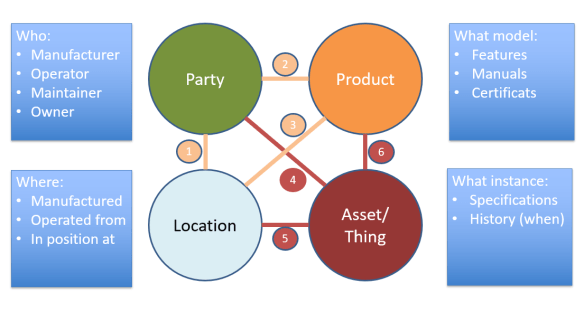
In the old MDM world with party, product and location we had 3 types of relationships between entities in these domains. With the inclusion of asset/thing we have 3 more challenging relationship types.

IoT and MDM

The Old MDM World

1: Handling the relationship between a party at its location(s) as for example a postal address and possibly also a geocode is one of the core capabilities of a proper party MDM solution.

2: Managing the relationship between parties and products is essential in supplier master data management and tracking the relationship between customers and products is a common multidomain MDM use case.

3:  Products are often related to a location, product features and not at least the language(s) used has a relation to locations and digital assets as certificates are location dependent.

The New MDM World

4: We need to be aware of who owns, operates, maintains, manufactured and have other party roles with any smart device being a part of the Internet of Things.

5: In order to make sense of the big data coming from fixed or moving smart devices we need to know the location context.

6: Further, we must include the product information of the product model for the smart devices.

Extended MDM Platforms

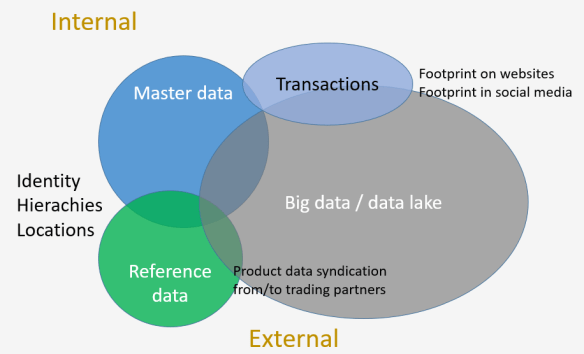
There is a tendency on the Master Data Management (MDM) market that solutions providers aim to deliver an extended MDM platform to underpin customer experience efforts. Such a platform will not only handle traditional master data, but also reference data, big data (as data lakes) either directly or by linking to the data in there as well as linking to transactions.

The recent acquisition of AllSight by Informatica is an example hereof.

In this context traditional MDM will, supplemented with Reference Data Management (RDM), enable the handling of:

  • Customer, supplier and product identity
  • Customer, supplier and product hierarchies
  • Customer, supplier and product locations

Additionally, the data lake concept can be used for:

Extended MDM Platforms

What is your view: Should MDM solution providers stick to traditional master data or should they strive to encompass other kinds of data too?

Artificial Intelligence (AI) and Master Data Management (MDM)

One of the hottest topics in the Master Data Management (MDM) realm right now is how Artificial Intelligence (AI), Machine Learning (ML) and Master Data Management stick together.

The MDM platform vendors are thus also busy with promoting the AI and ML capabilities within their offerings.

Some examples are:

Reltio: The Reltio page on AI, ML and Deep Learning (DL) focusses on two main scenarios:

  • Continuously improving consistency, accuracy, and manageability for better data quality (DQ), uncovering patterns, anomaly detection and streamlining data-driven jobs.
  • Using data-driven applications to enable a seamless foundation for the generation of relevant insights and contextual recommended actions.

Riversand: In a post called Cloud multi-domain MDM as the foundation for Digital Transformation Riversand CEO Upen Veranasi emphasized that enterprises want to better understand their customers (utilizing customer insights through AI), create/sell products and services that meet and exceed customer expectations (product positioning through AI), meet their customers across all touch points (channel management), secure their customer’s information (privacy), and interact with trading partners to creating cutting edge product differentiation (cloud and AI).

Enterworks: In a recent Enterworks product announcement it was stressed that “future proofing” investments mean that core data management hubs can provide the data to harness the advances in other technologies, such as AI and machine learning.

Artificial Intelligence is also a frequent topic on MDM conferences around. The MDM Summit Europe 2019 in London is no exception with multiple sessions touching on the connection between AI and MDM – with the presentation from yours truly as an example. You can view the entire agenda for this event here.

AI