Third-Party Data Enrichment in MDM and DQM

An often-requested capability in Master Data Management (MDM) and Data Quality Management (DQM) is data enrichment from – and verification against – third-party data providers. The data providers can be government data providers, commercial data providers and open data providers.

The two most common used scenarios are:

  • Data enrichment from – and verification against – business directories
  • Verification against – and enrichment from – address directories

Business directory integration

Integration with business directories is done with party master data as B2B customers and suppliers. The aim is often to enrich already gathered internal master data with external data such as:

  • Industry sector codes as SIC or NACE codes
  • Company family trees
  • Credit worthiness supporting data

Sometimes you may also want to (conditionally) overwrite – or supplement – internal gathered data such as:

  • Company name
  • Addresses
  • Phone numbers

You may also want to verify that a business exists and catch when a business dissolve.

Integration can be done with:

  • Global business directories, where Dun & Bradstreet is the most prominent. The advantage here is a uniform integration point and data structure.
  • National directories for each country often supplied by a government body. The advantage here is localized data fit for national requirements and optimal freshness.

Address verification

Verifying a postal address – and translating it into a standard format – is done with location master data that most often are part of party master with emphasis on B2C customer data.

Also, in this case there are global versus national options.

Some MDM / DQM providers have their own global services. Examples are Informatica, who acquired the service called Address Doctor, and IBM. Other MDM / DQM providers utilize the service called Loqate. The advantage here is a uniform integration point and data structure.

In many countries there are also national services that provides richer and localized data with optimal freshness. The richness may be multi-language versions, granular structures feasible in that country and property data such as which kind of building that exist on that address.

A common enrichment type is also getting the geocodes related to a postal address.

Your requirements

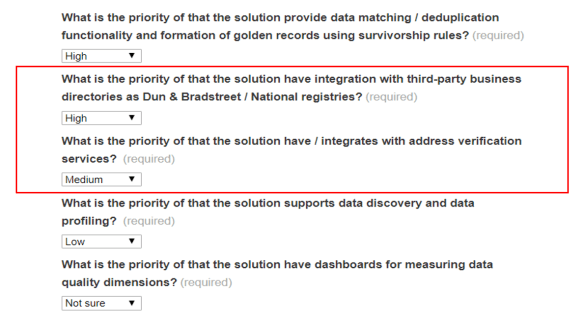
Your prioritization of business directory integration and address verification is part of the selection criteria here on the site in the Select your solution service.
Thrid party

Five Essential MDM / PIM Capabilities

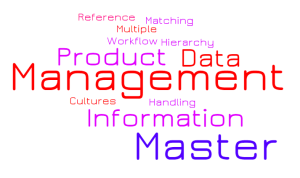
Many of the recent posts here on the blog have been around some of the most essential capabilities that Master Data Management (MDM) and Product Information Management (PIM) solutions are able to provide.

Five MDM PIM CapabilitiesData Matching

Having the ability to match and link master data records that are describing the same real-world entity is probably most useful in MDM and in the context of party master data. However, there are certainly also scenarios where product master data must be matched. While identifying the duplicates is hard enough, there must also be functionality to properly settle the match as explained in the post Three Master Data Survivorship Approaches.

Workflow Management

While the first MDM / PIM solutions emphasized on storing “a single source of truth” for master data, most tools today also provide functionality for processing master data. This is offered through integrated workflows as examined in the post Master Data Workflow Management.

Hierarchy Management

Master data comes in hierarchies (and even graphs). Examples are company family trees, locations and product classifications as told in the post Hierarchy Management in MDM and PIM.

Handling Multiple Cultures

If your solution will be implemented across multiple countries – and even in countries with multiple languages – you must be able to manage versions of master data and product information in these languages and often also represented in multiple alphabets and script systems. This challenge is described in the post Multi-Cultural Capabilities in MDM, PIM and Data Quality Management.

Reference Data Management

The terms master data and reference data are sometimes used synonymously. The post What is Reference Data Management (RDM)? is about what is usually considered special about reference data. Some MDM (and PIM) solutions also encompasses the handling of reference data.

The Capabilities That You Need

The above-mentioned capabilities are just some of the requirements you can mark in a service that can draft a list of MDM/PIM/DQM tools that are most relevant for you. Try it here: Select your solution.

DQM Tools In and Around MDM Tools

Data Quality Management (DQM) and Master Data Management (MDM) are overlapping disciplines within data management. An obvious reason for this overlap is that most data quality challenges are found in master data. Prominent examples are duplicates in customer master data, inaccurate location master data and incomplete product information.

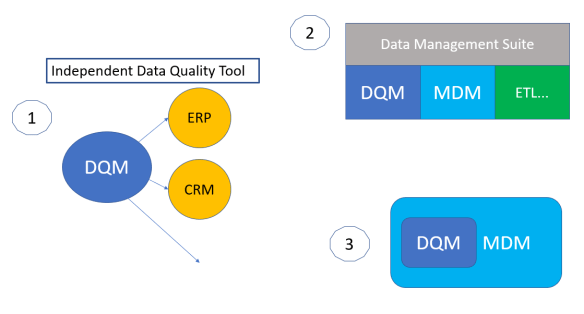
In this spectrum we have three kinds of tools on the market:

  1. Independent data quality tools that are mainly emphasizing on these capabilities:
    • Data matching with the aim of identifying duplicates and making a link between two or more data records that describes the same real-world entity.
    • Data profiling with the aim of identifying and quantifying data quality issues as anomalies, inconsistency and incompleteness.
  2. Data quality tools offered under the same brand and packaged together with MDM tools and other data management tools in a data management suite.
  3. Data quality capabilities as data matching and data profiling built into (extended) MDM platforms.

The results (golden records) from independent data quality tools can be stored and maintained in the master data part of business applications as ERP and CRM systems – or a separate MDM platform.

DQM in and around MDM

The ability to settle a more complex result of for example deduplication, as explained in the post Three Master Data Survivorship Approaches, can drive the requirement of which of the above-mentioned tools that will serve your organization best.

This list welcomes all the mentioned DQM offerings. Check out the current list here.

What is Reference Data Management (RDM)?

One of the specialized data management solution types encompassed by this Disruptive MDM / PIM / DQM List is Reference Data Management (RDM).

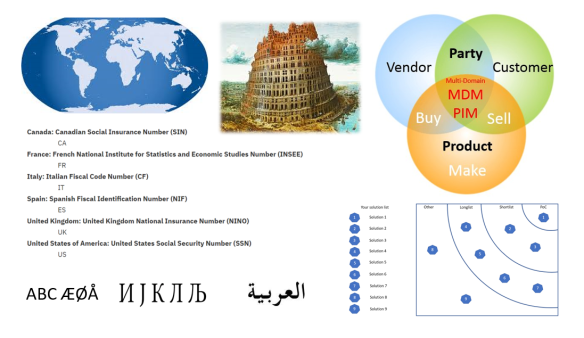
Reference data are typically smaller lists of data records that are referenced by master data and transaction data. These lists do not change often. They tend to be externally defined but can also be internally defined within each organization. The below table have some examples of reference data lists used across many organizations and industries:Reference DataRDM solutions may offer this functionality around the reference data:
  • The data store that holds the data
  • The user interface for maintaining the lists
  • Access control
  • Hierarchy management as for example how countries have (or not have) states/provinces that have postal codes
  • Managing relationships and mapping between the list values as for example how a SIC industry sector code relates to NACE industry sector codes
  • Versioning of the lists
  • Language and further context management
  • Audit trails
  • Approval workflows
  • Data integration capabilities

There are applications that is purely focussing on RDM as well as MDM and broader data management solutions / suites that have RDM as a one of several capabilities where the above-mentioned functionality is shared with master data and perhaps other critical application data.

If you use the select your solution service here on the site, RDM is one of the capabilities you can mark as a requirement for your solution.

Multi-Cultural Capabilities in MDM, PIM and Data Quality Management

When implementing Master Data Management (MDM), Product Information Management (PIM) and Data Quality Management (DQM) solutions in international environments – and even in national environments in countries with more than one official language – there will be some requirements around multi-cultural aspects of the solution. These are namely:

  • Multi-language capabilities
  • Handling different character sets and script systems
  • Utilizing third party reference data

Multi-language capabilities

A lot of master data elements can be represented in different languages. Examples are:

  • City names
  • Product classifications
  • Product descriptions

The ability to store master data in different language versions, validate according to the language in play and consume the data in the right context can be an essential factor when selecting the right tool and configuration of a tool.

When doing a Proof of Concept of a solution where the end environment will be international, you must do the pilot covering several languages.

Character sets and script systems

Critical data elements must often be kept in versions covering more than one character set or even script system. Examples are:

  • Person and company names
  • Postal addresses
  • Product features

While most solutions in the MDM, PIM and DQM space has developed a lot since examples of only covering the English alphabet in capital letters, there are still capability gaps worth exploring before implementing your solution in all corners of the world.

Third party reference data

The availability and requirements around referencing and enriching with third party data from public, commercial and open sources differs a lot from country to country. This includes:

  • External company IDs as Legal Entity Identifiers, Duns Numbers, national registration numbers (SIREN, ABN, KvK, CVR…..) and VAT numbers.
  • External person IDs as national ID systems (SSN, NINO, NIF, CF, INSEE, SIN, CPR ….)
  • Postal code systems (ZIP, PLZ, PIN ….) and address directories for the given country.

When working with third party reference data for purposes of unique identification, enrichment and validation you must strike a balance between having a uniform global process and local best practices (and lawful processes) for each master data domain.

Some solutions are very fit for a given geography but may have challenges in other geographies.

Your context, scope and requirements

When selecting an MDM, PIM and/or DQM solution you must take relevant multi-cultural capabilities into consideration. The tool selection help service on this site also covers the multi-cultural context, scope and requirements. You can access Select your solution here.

Multi Cultural MDM PIM DQM

PS: The tower shown is The Tower of Babel.