Fashion vs Work Clothes: A PIM Perspective

In data management disciplines as Master Data Management (MDM), Product Information Management (PIM and Data Quality Management (DQM) the context has a lot say for data that fundamentally are the same. One example is fashion vs work clothes as it applies to PIM and data quality measures required .

Clothes for private (and white collar) use and work clothes are as products quite similar. You have the same product groups as shoes, trousers, belts, shirts, jackets, hats and so on.

However, the sales channels have different structures and the product information needed in sales, not at least self-service sales as in ecommerce, are as Venus and Mars.

Online fashion sales are driven by nice images – nice clothes on nice models. The information communicated is often fluffy with only sparse hard facts on data like fabrics, composition, certificates, origin. Many sales channel nodes only deal with fashion.

Selling work clothes, including doing it on the emerging online channels, does include images. But they should be strict to presenting the product as is. There is a huge demand for complete and stringent product information as we know it in B2B (online) sales.

Work clothes are often sold in conjunction with very different products as building materials, where the requirements for product information attributes are not the same. Work clothes comes, as fashion, in variants in sizes and colors. This is not so often used, or used quite differently, when selling for example building materials.

One challenging area here is where we have work clothes and building materials in the same data pool or in other means of Product Data Syndication (PDS).

Work Clothes versus Fashion

Are These Familiar Hierarchies in Your MDM / PIM / DQM Solution?

The term family is used in different contexts within Master Data Management (MDM),  Product Information Management (PIM) and Data Quality Management (DQM) when working with hierarchy management and entity resolution.

Here are three frequent examples:

Consumer / citizen family

Family consumer citizenWhen handling party master data about consumers / citizens we can deal with the basic definition of a family, being a group consisting of two parents and their children living together as a unit.

This is used when the business scenario does not only target each individual person but also a household with a shared economy. When identifying a household, a common parameter is that the persons live on the same postal address (at the same time) while observing constellations as:

  • Nuclear families consisting of a female and a male adult (and their children)
  • Rainbow families where the gender is not an issue
  • Extended families consisting of more than two generations
  • Persons who happen to live on the same postal address

There are multicultural aspects of these constellations including the different family name constructions around the world and the various frequency and acceptance of rainbow families as well of frequency of extended families.

Company family tree

When handling party master data about companies / organizations a valuable information is how the companies / organizations are related most commonly pictured as a company family tree with mothers and sisters. This can in theory be in infinite levels. The basic levels are:

  • A global ultimate mother being the company that ultimately owns (fully or partly) a range of companies in several countries.
  • A national ultimate mother being the company that owns (fully or partly) a range of companies in a given country.
  • A legal entity being the basic registered company within a country having some form of a business entity identifier.
  • A branch operated by a legal entity from a given postal / visiting address.

Family companyYou can build your own company tree describing your customers, suppliers and other business partners. Alternatively or supplementary, you can rely on third party business directories. It is here worth noticing that a national source will only go to the ultimate national mother level while a global source can include the global ultimate mother and thus form larger families.

Having a company family view in your master data repository is a valuable information asset within credit risk, supply risk, discount opportunities, cross-selling and more.

Product family

The term “product family” is often used to define a level in a homegrown product classification / product grouping scheme. It is used to define a level that can have levels above and levels below with other terms as “product line”, “product category”, “product class”, “product group”, “product type” and more.

Family productSometimes it is also used as a term to define a product with a family of variants below, where variants are the same product produced and kept in stock in different colours, sizes and more.
Read more about Stock Keeping Units (SKUs), product variants, product identification and product classification in the post Five Product Information Management Core Aspects.

Generic Ranking of Vendors versus an Individual Selection Service

Many analysts market reports in the Master Data Management (MDM), Product Information Management (PIM) and Data Quality Management (DQM) space has a generic ranking of the vendors. Some of these reports were back in December last year mentioned in the post Major Generic MDM / PIM / DQM Solution Rankings. (Since then a new Gartner MDM Magic Quadrant has been published).

The trouble with generic ranking is that one size does not fit all. Therefore organizations on the look for a solution need to examine the market anyway and spend a lot of time and/or money with consultants in doing that.

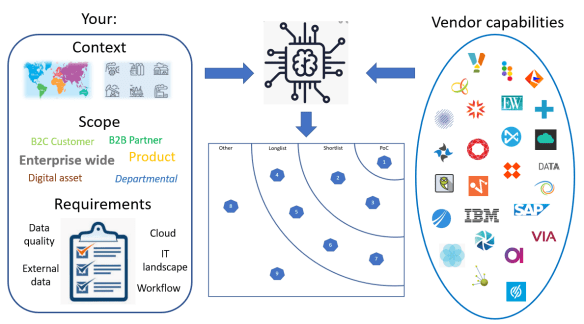
On this list there is no generic ranking. Instead there is a service where you can provide your organization’s context, scope and requirements and within 2 to 48 hours get your solution list.

The selection model includes these elements:

  • Your context in terms of geographical reach and industry sector.
  • Your scope in terms of domains to be covered and organizational scale stretching from specific departments over enterprise wide to business ecosystem wide (multi-enterprise).
  • Your specific requirements.
  • Vendor capabilities.
  • A model that combines those facts into a rectangle where you can choose to:
    • Go ahead with a Proof of Concept with the best fit vendor
    • Make an RFP with the best fit vendors in a shortlist
    • Examine a longlist of best fit vendors and other alternatives like combining more than one solution.

Selection Model

You can get your free solution list here.

Note that the solution vendors considered are those who are:

  • On this Disruptive MDM / PIM / DQM Solutions List or
  • Gartner MDM Magic Quadrant or
  • Forrester MDM Wave or Forrester PIM Wave or
  • Information Difference MDM Landscape

Major Generic MDM / PIM / DQM Solution Rankings

Analyst firms occasionally publish market reports with a generic ranking of solutions for MDM, PIM and DQM.

The latest such ones include:

The publication schedule from the analyst firms can be unpredictable.

Information Difference is an exception. There have during the years every year been a Data Quality landscape named Q1 and published shortly after that quarter and an MDM landscape named Q2 and published shortly after that quarter. However, these reports are relying on participation from relevant vendors and not all vendors prioritize this scheme.

Forrester is quite unpredictable both with timing and which market segments (MDM, PIM, DQM) to be covered.

Gartner is a bit steadier. However, for example the MDM solution reports have been coming in varying intervals during the latest years. Let us see when the next ones are published and what news they bring.

MDM PIM DQM Solutions

PS: You can check out many of the included solutions on This Disruptive MDM / PIM / DQM List.

PPS: You can get a free ranking based on your context, scope and requirements here.

Jumpstart Your MDM / PIM / DQM Solution Selection

The solution selection service on this site started 3 months ago as told here.

Since then Master Data Management (MDM) and Product Information Management (PIM) solutions have been joined by Data Quality Management (DQM) solutions, where some of the most innovative DQM solutions have joined the listing on this site.

More than 50 requesters have provided information about the context, scope and requirements of their intended solution and based on that received a report telling:

  • Your solution listWhich solution that is the best fit for a direct proof of concept
  • Which 3 solutions that are the best fit for a shortlist of solutions
  • Which 7 solutions that are the best fit for a longlist of solutions

Depending on your organization’s rules and the circumstances of your solution selection this report is aimed to jumpstart your selection process using one of the above selections.

The requesters of this report that have given feedback have provided positive responses as told in the post about the First Experiences with the MDM / PIM Solution Selection Service.

The service is still free. Start here.