
Within Master Data Management (MDM), Product Information Management (PIM) and Data Quality Management (DQM) one of the critical data elements that needs to be governed is the product name (product description).
Usually the product name is held in two forms:
- A short form as it appears internally in an organization and is held in an ERP application. Everyone working with SAP knows about the challenge of keeping the product description in SAP within 40 characters. The short form is typically governed within the MDM discipline and is kept in the single one official language in the organization.
- A long and customer friendly form as it is used when presenting the product in sales channels as for example on a web shop. The long form is typically governed within the PIM discipline and is kept in all languages in use in the organization.
The data quality dimensions that applies to the product name are namely:
- Uniqueness, meaning that:
- The product name must be the same (in short or long language form) across data stores in order to avoid duplicates.
- Each product most have a distinct name, so you are able to distinguish one from the other.
- Consistency, meaning that you must build the product name by sub elements that are sequenced the same way and have a common vocabulary.
The most common sub elements in a product name are:
- Brand name or product line
- Model number
- Kind of product
- Size
- Color
- Product classification (group) specific characteristics
- Country

It is a challenge to implement data governance around product names within a single organization. Even more it is a challenge to rely on / be depended on your trading partners when governing product names in business ecosystems as told in the post Toilet Seats and Data Quality.
 When handling party master data about consumers / citizens we can deal with the basic definition of a family, being a group consisting of two parents and their children living together as a unit.
 You can build your own company tree describing your customers, suppliers and other business partners. Alternatively or supplementary, you can rely on third party business directories. It is here worth noticing that a national source will only go to the ultimate national mother level while a global source can include the global ultimate mother and thus form larger families.
 Sometimes it is also used as a term to define a product with a family of variants below, where variants are the same product produced and kept in stock in different colours, sizes and more.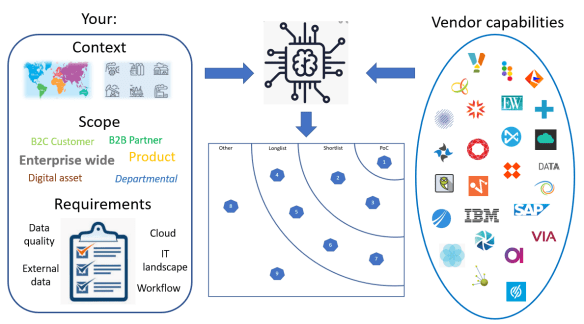

 Which solution that is the best fit for a direct proof of concept
 The Disruptive MDM / PIM / DQM List