MDM, PIM, DAM within Data Management

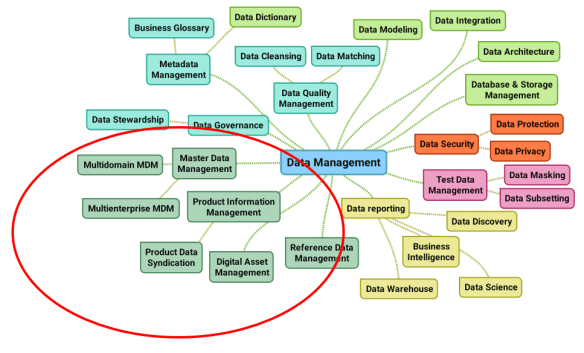
Master Data Management (MDM), Product Information Management (PIM) and Digital Asset Management (DAM) are some interrelated disciplines that again is interrelated with other disciplines in the data management space.
MDM PIM DAM and Data Management

The core disciplines are:

  • MDM has some sub disciplines, most notable:
    • Multidomain MDM which is when the MDM effort encompasses not only a single master data domain as for example customer, supplier, employee (all being party master data) or product master data but all master data domains relevant for a given organization.
    • Multienterprise MDM which is an emerging discipline where the scope of sharing master data goes from doing that within a given organization to embracing the business ecosystem(s) where the organization operates.
  • PIM can be seen as an extension to product master data management which takes care of the product information in marketing and sales scenarios. In addition:
    • PIM has some overlapping acronyms as PCM, PDM, PLM and PxM as discussed in the post Product Something Management.
    • Product Data Syndication is the multienterprise (business ecosystem wide) scenario related to PIM, where product information is shared between trading partners (or between disconnected entities belonging to the same organization).
  • DAM is most commonly related to PIM and the requirement for handling digital assets as images, textual documents, videos and more related to products, but the digital assets can also relate to other master data entities.

Reference Data Management (RDM) is closely related to these disciplines as told in the post RDM: A Small but Important Extension to MDM.

Data Governance can be seen as an overarching discipline for data management and should also go hand in hand with MDM, PIM and DAM. A core result from MDM, PIM and DAM activities is to provide sustainable data quality so that data cleansing and data matching does not have to be done over and again.

MDM and RDM underpins data reporting activities, Test Data Management (TDM) and data security and MDM, PIM and DAM is an essential aspect of data architecture, data modelling and data integration.

If you are considering solutions for MDM, PIM and DAM, our list features some of the best solutions from the most forward-looking vendors on the market. Check it out here.

MDM versus ADM

The term Application Data Management (ADM) has been circulating in the Master Data Management (MDM) world for some time as touched in the post MDM Fact or Fiction: Who Knows?

Not at least Gartner, the analyst firm, has touted this as one of two Disruptive Forces in MDM Land. The two terms MDM and ADM relates as seen below:

ADM MDM.png

So, ADM takes care of a lot of data that both is master data but also data that we do not usually consider being master data within a given application while MDM takes care of master data across multiple applications.

The big question is how we handle the intersection (and sum of intersections in the IT landscape) when it comes to applying technology.

If you have an IT landscape with a dominant application like for example SAP ECC you are tempted to handle the master data within that application as your master data hub or using a vendor provided tightly integrated tool as for example SAP MDG. For specific master data domains, you might for example regard your CRM application as your customer master data hub. Here MDM and ADM melts into one process and technology platform.

If you have an IT landscape with multiple applications, you could consider implementing a specific MDM platform that receives master data from and provides master data to applications that takes care of all the other data used for specific business objectives. Here MDM and ADM will be in separated processes using best-of-breed technology.

Finally we also see platforms that previously were branded as MDM platforms but now evolves into general data management platforms covering more than just master data.

MDM Critical Data Elements

Please find below a mind map with some of the most common critical data elements that are considered to be master data:

Master Data Mind Map

The map is in no way exhaustive and if you feel some more very important and common data elements should be there, please comment.

The data elements are grouped within the most common master data domains handled today, being party master data, product master data and location master data.

Please find some more information about some of data elements here:

The mind map has a selection of flags around where master data are geographically dependent. Again, this is not exhaustive. If you have examples of diversities within master data, please also comment.

IoT and MDM

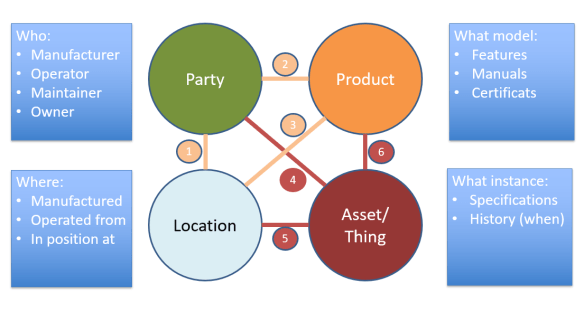
With the rise of Internet of Things (IoT), asset – seen as a thing – is seriously entering the Master Data Management (MDM) world. These things are smart devices that produces big data we can use to gain much more insight about parties (in customer and other roles), products, locations and the things themselves.

In the old MDM world with party, product and location we had 3 types of relationships between entities in these domains. With the inclusion of asset/thing we have 3 more challenging relationship types.

IoT and MDM

The Old MDM World

1: Handling the relationship between a party at its location(s) as for example a postal address and possibly also a geocode is one of the core capabilities of a proper party MDM solution.

2: Managing the relationship between parties and products is essential in supplier master data management and tracking the relationship between customers and products is a common multidomain MDM use case.

3:  Products are often related to a location, product features and not at least the language(s) used has a relation to locations and digital assets as certificates are location dependent.

The New MDM World

4: We need to be aware of who owns, operates, maintains, manufactured and have other party roles with any smart device being a part of the Internet of Things.

5: In order to make sense of the big data coming from fixed or moving smart devices we need to know the location context.

6: Further, we must include the product information of the product model for the smart devices.

4 MDM Definitions: Which One is the Best?

What is Master Data Management (MDM)? How can we define MDM?

Well, as with everything in life there are varying and competing definitions. Below you can find 4 different definitions:

Wikipedia: In business, Master data management (MDM) is a method used to define and manage the critical data of an organization to provide, with data integration, a single point of reference. In computing, a master data management tool can be used to support master data management by removing duplicates, standardizing data (mass maintaining), and incorporating rules to eliminate incorrect data from entering the system in order to create an authoritative source of master data. Master data are the products, accounts and parties for which the business transactions are completed.

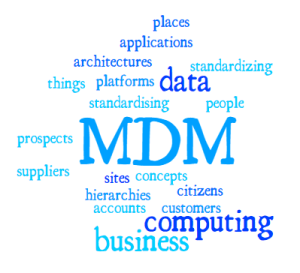
MDM Wordle

Gartner: Master data management (MDM) is a technology-enabled discipline in which business and IT work together to ensure the uniformity, accuracy, stewardship, semantic consistency and accountability of the enterprise’s official shared master data assets. Master data is the consistent and uniform set of identifiers and extended attributes that describes the core entities of the enterprise including customers, prospects, citizens, suppliers, sites, hierarchies and chart of accounts.

SearchDataManagement: Master data management (MDM) is a comprehensive method of enabling an enterprise to link all of its critical data to a common point of reference. When properly done, MDM improves data quality, while streamlining data sharing across personnel and departments. In addition, MDM can facilitate computing in multiple system architectures, platforms and applications.

Techopedia: Master data management (MDM) refers to the management of specific key data assets for a business or enterprise. MDM is part data management as a whole but is generally focused on the handling of higher level data elements, such as broader identity classifications of people, things, places and concepts.

Your definition: Which one of the four above-mentioned definitions do you prefer? Or is there a much better fifth one?