Five Steps to Guarantee a Successful Master Data Management Implementation

Today’s guest blog post is written by Nils Erik Pedersen of Stibo Systems. In here Nils Erik goes through five essential prerequisites for making your MDM implementation a success.

For any Master Data Management initiative to be a success, it’s important that initial preparations and considerations are in place. These are the steps you as a business cannot ignore when initiating any type of Master Data Management journey. The success of your initiatives depends on it.

#1. Establish your business vision and define Master Data Management’s role in it

Before you even decide which Master Data Management aspects and processes you need, you must start with focusing on something completely different than your data: Your business. What is your overall business vision? What is it that you specifically need to solve to fulfill that vision? I bet the answers to these questions to begin with won’t come down to “improving our data quality” or “create better workflows around our product on-boarding processes”.

But once you start drilling into your business vision and its components, you’ll probably find that processes around data quality and data workflows do in fact support your greater vision. But it’s a question of translating IT challenges into broader business problems, such as the challenge of creating a frictionless customer journey or how to empower your employees with the insights that they need.

If you view MDM as a business driver – a business problem solver instead of an IT problem solver – you’ll have an easier time getting buy-in from the rest of the business, as well as have a better foundation to measure the ROI of your investment.

#2. Identify what domain supports the first step toward your business vision

Let’s be honest. You cannot expect MDM to magically solve all your business issues overnight. The vast majority of successful multidomain MDM implementations are done with step-by-step approaches, where you gradually expand your solution from one to more data domains – e.g. your Product data domain, supplier data domain or customer data domain – and build on the experiences from the first domain(s). Step two is about zooming in on the areas of your business that will benefit most from better data quality and data processes and then focus on that. Is your vision to compete on ‘fastest with new products’? Then your product data may be the place to start. Or is it ‘providing the best customer service’? Then it’s probably customer data you need to focus on. Again, concentrate on what can be expected to bring you the greatest business value. And it is not necessarily the area that is the easiest or most obvious to fix.

#3. Create the foundation for MDM ROI

One of the challenges of Master Data Management and other data investments is that it can be hard to prove its business value in tangible quantities. But today, every ambitious enterprise wants to measure and analyze the Return on Investment (ROI) of every single investment. That’s why you need to pick your MDM related Key Performance Indicators (KPIs) in the very inaugural phase of implementing Master Data Management, so that you have a starting point to compare to later in the implementation.

But what KPIs can you measure? Although MDM in itself can be hard to measure, you can better quantify some of your business vision components. So, if one of the milestones in your overall business vision is to improve customer experience, you have to define: What components make up my CX? Those could be:

  1. Customer Service satisfaction
  2. Sales stats
  3. Direct marketing results
  4. Returned goods stats
  5. Shopping cart abandonment rates

Make sure you measure on those ROI metrics before, during and after implementing Master Data Management initiatives.

#4. Educate your business about the why

As soon as you’ve taken the very first steps down MDM lane, it’s time to launch the foundation for the cultural change that needs to happen in your business as the project progresses. Unfortunately, it is not enough that only a handful of employees – those who work closely with the project – know the value of good master data. The rest of the business must also understand this, more specifically why you as a business are doing it and what it means for them as employees. Everybody in the organization needs to be aware of data quality and data processes if the project is to succeed. This step is a rather educational task, and the way to do it is through lots of relevant communication – preferably communication from senior management, not the IT department.

#5. Make sure your strategy and system is scalable and integrational

The one mistake you don’t want to make is to let your early choices prohibit growth at a later stage. So now that you’ve reached the step where you want to start creating strategies and are looking for solutions, you should make sure that you prepare for the future by creating a strategy and bringing in a software solution with the ability to scale. A scalable solution enables you to later expand it into other domains and integrate it with data-driven applications and emerging technologies. That’s important to support future business growth as well as any future mergers or acquisitions.

If you can check these five steps before moving on to the next phase of your MDM initiative, then I believe you’re well off to a good start. What are your experiences with these steps? Are you looking to kick off a MDM project and have other considerations? Please share your thoughts in the comment field.

Nils Erik Pedersen is the Vice President of Product Strategy at Stibo Systems. Nils has a passion for process optimization and automation, in particular when it comes to handling data.  With a background and a career rooted in handling massive amounts of complex data at an enterprise level, he has been involved in many successful Master Data Management implementations. After 20+ years in the Master Data Management industry, and today holding a leading position within Stibo Systems, Nils has built a solid understanding of what makes or breaks Master Data Management implementations and what it takes to drive business value from enterprise data.


5 lanes

Why next generation MDM and PIM solutions must be in the Cloud

In this guest blog post Shamanth Shankar of Riversand explains why the next generation of Master Data Management (MDM) and Product Information Management (PIM) solutions must be deployed as cloud solutions.

As retailers grow, managing data across their application landscape becomes crucial. Business users and Information Technology (IT) leaders want to choose data management solutions that provide insights to them and provide relevant information to their customers along their purchasing life-cycle. Accommodating scale, speed and different data types requires that data management solutions evolve.

How are enterprises coping with scale and flexibility?

Enterprise software solutions are going through a revolution to accommodate scale and flexibility. Looking at the growth of AWS and Azure, one can imagine how aggressively enterprises are embracing cloud. AWS grew 54.9% year on year and Microsoft’s Azure grew  triple digits over the last five quarters. Cloud is growing at a 22% Compound Annual Growth Rate (CAGR), four times the rate of software spending growth. Flexibility in operating models (Operational Expense vs. Capital Expense), ease of implementation and cost savings lure business leaders towards the cloud. To strike a balance with the legacy of on premise solutions and cloud-based business friendly applications, enterprises will pursue a hybrid cloud model.

Cloud and Retailers

Compared to other verticals, retail has a lower barrier to adopting cloud. Cloud is expected to grow five-fold in retailing. Additional data points supporting this continued accelerated growth of cloud-based solutions, include;

  • Digital commerce platforms are growing at 15% CAGR, driven by SaaS revenues.
  • Non-Store retailers reported 12% year on year growth per the US Department of Commerce.

Retailers invest in various hybrid cloud-based solutions throughout their enterprise to providetheir consumers with personalized attention, constant engagement and better experiences.The central focus of this effort is to provide business users with a better user experience along with consistent data (especially product data) all with the goal of creating great experiences for consumers.

Product Information Management Solution

Synchronization of product data across applications and channels is critical to enterprises for improved efficiencies, faster new product introduction and higher sales. A Product Information Management (PIM) solution provides a single source of truth, high quality product content, global product taxonomies, aggregation and syndication with internal and external sources.

PIM solutions improve sales by providing the right product for the right customer at the right time, improve efficiencies by accelerating new product introduction, reduce supply chain costs and identify bottlenecks through better reporting. By connecting with data pools, vendor data, marketplaces, e-commerce platforms and Digital Asset Management solutions, PIM solutions connect to the entire application ecosystem and keep all the business users on the same page with “Trusted Product Data”. The foundation of this “Trusted Product Data” drives an enterprise towards data-driven and outcome based operations. In such an ecosystem, data models are defined, product data is mapped to marketplace structures, outcomes are measured and changes are accommodated on a periodic basis.

Transformation in Product Information Management

As retailers grow (organically or through acquisition), data models need to be changed, infrastructure needs to be expanded and global variations need to be consolidated into one solution. In addition to strategic topline growth, changing consumer choices, interactions and sentiments force business transformations.

Business leaders and IT leaders want to gain insights from their PIM solution and ensure they are providing relevant information to their customers. They expect a PIM solution to help them solve the following:

Assortment and Product Intelligence

Can they match the relevant assortment and products to the respective consumer segments, and understand  particular consumer’s sentiments?

Channel and Operational Intelligence

 How are the products performing on various channels and what impact does product data quality have on supply chain costs?

Competitive Intelligence

Does the competition differ by merchandising category?
How is the merchandise performing compared to the competition?

Both business and IT users are looking to accommodate this inward-looking information into their application ecosystem.

IT teams are finding it challenging to correlate external data with their internal data management practices. They are looking for cost effective technologies that can provide insights into underperforming product segments.

Merchandising teams curating product content have limited to nonexistent abilities to map or correlate product content to consumer segments, competitors, or sentiment via social channels.

Customer service teams are trying to analyze and draw insights from consumer and market segment analysis and marry them with category specific context.

Next Generation Solution

Current data management solutions need to evolve to manage increasing master data  and related expanding data pools at scale. These solutions will have to be based on hybrid technology frameworks involving SQL, NoSQL, Graph and persist both structured and unstructured data. To provide higher Return on Investment and lower Total Cost of Ownership to retailers, such solutions will need to be able to scale in or out with a pay-as-you-go model. Considering that enterprises will continue supporting on premise, private cloud and public cloud models, PIM solutions must provide all these capabilities both on premise and in the cloud.

Next Generation data management will bring global business complexities together into a single solution that is web-scale, dynamically configurable and offers the best user experience for both business and IT teams.

Shamanth Shankar supports business operations at Riversand. Till recently Shamanth led Marketing at Riversand. Prior to Riversand Shamanth consulted clients on Data & Analytics products, led S&OP at a manufacturing company and managed a Product Line at a public company. Shamanth holds degrees from Rice, Texa A&M and IIT Madras.

industry and Internet of Things concept. woman working in factory and wireless communication network. Industry4.0.

3 Reasons MDM No Longer Delivers a Customer 360

Today’s guest blog post is from David Corrigan, CEO at AllSight

When Master Data Management (MDM) and Customer Data Integration (CDI) were designed over 15 years ago, they were touted as the answer to “Customer 360”.  But the art of mastering data and the art of creating a complete view of a customer are two very different things.  MDM is focused on managing a much smaller, core data set and aims to very deeply and truly master it.  Customer 360 solutions focus on “all data about the customer” to get the complete picture.  When it comes to a 360-degree view of the customer, master data is only part of the story.  Additional data has to be part of the 360 in order to have a full understanding of the customer – whether that be an individual or an organization. Additional data sources and data types required for today’s Customer 360 include transactions, interactions, events, unstructured content, analytics and intelligence – all of which are not managed in MDM.

Today, leading organizations are looking beyond MDM to a new era of Customer 360 technology to deliver the elusive complete view of the customer.  Here are 3 reasons why

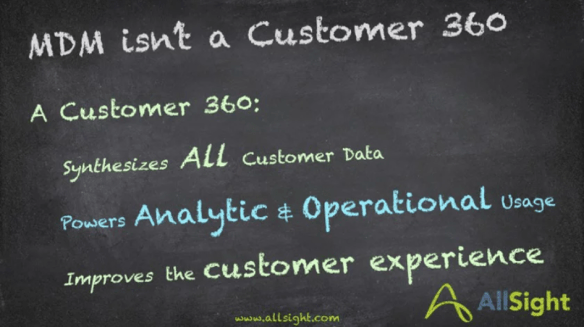
  1. Customer 360 needs all data; MDM only stores partial data.  MDM focuses on core master data attributes, matching data elements and improving data quality.  Customer 360 has rapidly evolved requiring big data sets such as transactions and interactions, as well as unstructured big data like emails, call center transcriptions, and web chat interactions not to mention social media mentions, images and video.
  2. Customer 360 must serve analytical and operational needs; MDM only supports operational processing.  The original intent of MDM was to provide ‘good’ data to CRM and transactional systems.  While a branch of MDM evolved for ‘analytical MDM’ use cases, it was really a staging area for quality and governance to occur before data was loaded into warehouse for analysis and reporting.  A Customer 360 is meant to be analyzed and used by marketing analysts, data scientists as well as customer care and sales staff – it powers many different personas with different perspectives of the customer.
  3. Customer 360 is about improving the customer experience; Master data (core data) is used during a customer experience. Master Data is required during a customer interaction to understand key facts about a customer including name, contact info, account info, etc.  But the Customer 360 needs to blend all interactions, transactions and events into a comprehensive customer journey in order to analyze and personalize customer experiences.

But why does a Customer 360 now require all this information and capabilities beyond traditional MDM?  It is because the expectations of customers and the demands they make on businesses have changed.  Customers want personalized service and they want it now.  And they want a consistent experience across all channels – online, via phone, and in store.  They don’t want to have to repeat themselves or their preferences every time they interact with a business.  This requires companies to know more about their customers and to anticipate their next move in order to retain their business and loyalty.  Because, not only are customers more demanding than ever, but it is also easier for them to switch brands with little to no cost.

In order to meet these demands, many organizations assume they need to build these capabilities on their own using new technologies such as Apache Hadoop and Graph data stores.  These technologies can join together silos of master data, transactional data, raw data lake data, and experience/journey analytics.  However, a new class of software is emerging that bridges data, analytics and action and is based on these modern technologies. Customer Intelligence Platforms manage all customer information and synthesize it into an intelligent Customer 360.  Synthesizing all of those data sources is no easy task and that is where many organizations stall out.  What’s required is a machine-learning contextual matching engine that automates the process of linking customer data and evaluates data confidence.

Organizations such as Dell are seeing this shift first hand and have recognized that legacy MDM apps alone aren’t cutting it.  Deotis Harris, Senior Director, MDM at Dell EMC said “We saw an opportunity to leverage AllSight’s modern technology (Customer Intelligence), coupled with our legacy systems such as Master Data Management (MDM), to provide the insight required to enable our sellers, marketers and customer service reps to create better experiences for our customers.”

If you are like Dell and so many other organizations, a Customer 360 is high on your priority list.  A Customer Intelligence Platform might just be your next step.

MDM not 360