B2B2C in MDM, PIM and DQM

The Business-to-Business-to-Consumer (B2B2C) scenario is becoming of increasing importance in Master Data Management (MDM), Product Information Management (PIM) and Data Quality Management (DQM).

This scenario is usually seen in manufacturing including pharmaceuticals as examined in the post Six MDMographic Stereotypes.

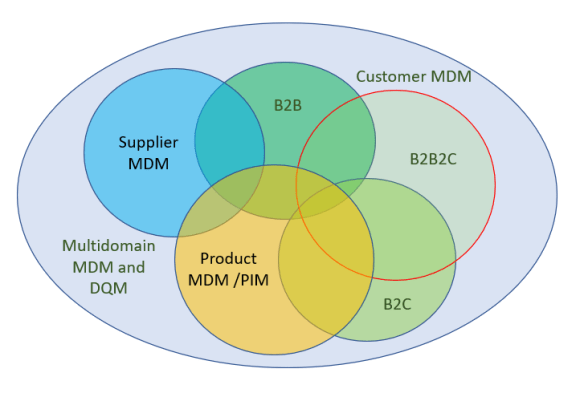
One challenge here is how to extend the capabilities in MDM / PIM / DQM solutions that are build for Business-to-Business (B2B) and Business-to-Consumer (B2C) use cases. Doing B2B2C requires a Multidomain MDM approach with solid PIM and DQM elements either as one solution, a suite of solutions or as a wisely assembled set of best-of-breed solutions.
B2B2C MDM PIM DQM

In the MDM sphere a key challenge with B2B2C is that you probably must encompass more surrounding applications and ensure a 360-degree view of party, location and product entities as they have varying roles with varying purposes at varying times tracked by these applications. You will also need to cover a broader range of data types that goes beyond what is traditionally seen as master data.

In DQM you need data matching capabilities that can identify and compare both real-world persons, organizations and the grey zone of persons in professional roles. You need DQM of a deep hierarchy of location data and you need to profile product data completeness for both professional use cases and consumer use cases.

In PIM the content must be suitable for both the professional audience and the end consumers. The issues in achieving this stretch over having a flexible in-house PIM solution and a comprehensive outbound Product Data Syndication (PDS) setup.

As the middle B in B2B2C supply chains you must have a strategic partnership with your suppliers/vendors with a comprehensive inbound Product Data Syndication (PDS) setup and increasingly also a framework for sharing customer master data taking into account the privacy and confidentiality aspects of this.

This emerging MDM / PIM / DQM scope is also referred to as Multienterprise MDM.
The Free Bespoke MDM / PIM / DQM Solution Ranking Service

This site has an interactive service to help you jumpstart in your tool selection for a solution for Master Data Management (MDM), Product Information Management (PIM) and/or Data Quality Management (DQM).

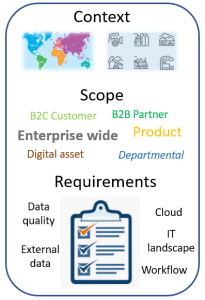
MDM PIM DQM Context, Scope and RequirementsThe selection model is based on the context, scope and requirements for your solution.
The context includes the geographical reach and the industry where your organization operates.

The scope includes the number of entities as for example consumers (B2C customers), companies (B2B customers, suppliers and other business partners), products and digital assets as well as the organizational reach.

The requirements are those that differentiate the MDM / PIM / DQM solutions on the market.

MDM PIM DQM Vendor capabilitiesThe solution capabilities considered in the selection process are those of who are:

  • On this Disruptive MDM / PIM / DQM Solutions List or
  • Gartner MDM Magic Quadrant or
  • Forrester MDM Wave or Forrester PIM Wave or
  • Information Difference MDM Landscape

MDM PIM DQM AI EngineThese two sets of information are compared in a continuously supervised learning algorithm – also known in marketing as machine learning and artificial intelligence (AI).
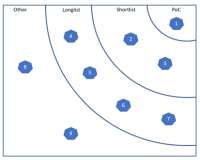
Filling in the information usually takes less than 15 minutes. You will get your solution list within 1 to 48 hours.

MDM PIM DQM Ranking OutcomeThe outcome is:

  • The best fit solution for a Proof of Concept
  • Two more solutions to be in a shortlist
  • Four more solutions to be in a longlist
  • If fit, a couple of more solutions to be considered as alternatives or supplements

During the half year this service has been online, more than 100 end user organizations or their consultants have received their solution list.

This service is free. No information is shared with anyone unless requested. Are you ready? Start with step 1 here.

An MDM / PIM / DQM Easter Egg

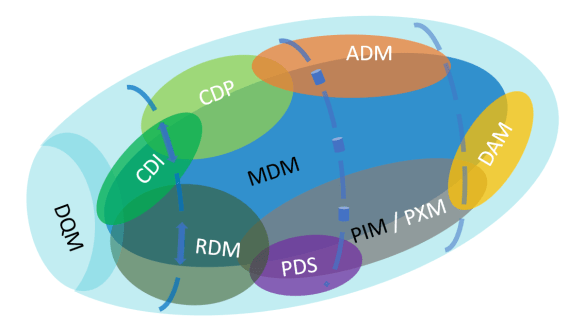
It is high season for painting Easter eggs now.MDM PIM DQM Easter EggThis egg is featuring:

  • Master Data Management (MDM),
  • Product Information Management (PIM) and/or
  • Data Quality Management (DQM)

as well as:

  • Application Data Management (ADM),
  • Customer Data Integration (CDI),
  • Customer Data Platform (CDP),
  • Digital Asset Management (DAM),
  • Product Data Syndication (PDS),
  • Product experience Management (PXM) and
  • Reference Data Management (RDM)

Check out the 10 data management TLAs on this list here.

What’s in a Product Name?

Within Master Data Management (MDM), Product Information Management (PIM) and Data Quality Management (DQM) one of the critical data elements that needs to be governed is the product name (product description).

Usually the product name is held in two forms:

  • A short form as it appears internally in an organization and is held in an ERP application. Everyone working with SAP knows about the challenge of keeping the product description in SAP within 40 characters. The short form is typically governed within the MDM discipline and is kept in the single one official language in the organization.
  • A long and customer friendly form as it is used when presenting the product in sales channels as for example on a web shop. The long form is typically governed within the PIM discipline and is kept in all languages in use in the organization.

The data quality dimensions that applies to the product name are namely:

  • Uniqueness, meaning that:
    • The product name must be the same (in short or long language form) across data stores in order to avoid duplicates.
    • Each product most have a distinct name, so you are able to distinguish one from the other.
  • Consistency, meaning that you must build the product name by sub elements that are sequenced the same way and have a common vocabulary.

The most common sub elements in a product name are:

  • Brand name or product line
  • Model number
  • Kind of product
  • Size
  • Color
  • Product classification (group) specific characteristics
  • Country

What is in a product name

It is a challenge to implement data governance around product names within a single organization. Even more it is a challenge to rely on / be depended on your trading partners when governing product names in business ecosystems as told in the post Toilet Seats and Data Quality.

Are These Familiar Hierarchies in Your MDM / PIM / DQM Solution?

The term family is used in different contexts within Master Data Management (MDM),  Product Information Management (PIM) and Data Quality Management (DQM) when working with hierarchy management and entity resolution.

Here are three frequent examples:

Consumer / citizen family

Family consumer citizenWhen handling party master data about consumers / citizens we can deal with the basic definition of a family, being a group consisting of two parents and their children living together as a unit.

This is used when the business scenario does not only target each individual person but also a household with a shared economy. When identifying a household, a common parameter is that the persons live on the same postal address (at the same time) while observing constellations as:

  • Nuclear families consisting of a female and a male adult (and their children)
  • Rainbow families where the gender is not an issue
  • Extended families consisting of more than two generations
  • Persons who happen to live on the same postal address

There are multicultural aspects of these constellations including the different family name constructions around the world and the various frequency and acceptance of rainbow families as well of frequency of extended families.

Company family tree

When handling party master data about companies / organizations a valuable information is how the companies / organizations are related most commonly pictured as a company family tree with mothers and sisters. This can in theory be in infinite levels. The basic levels are:

  • A global ultimate mother being the company that ultimately owns (fully or partly) a range of companies in several countries.
  • A national ultimate mother being the company that owns (fully or partly) a range of companies in a given country.
  • A legal entity being the basic registered company within a country having some form of a business entity identifier.
  • A branch operated by a legal entity from a given postal / visiting address.

Family companyYou can build your own company tree describing your customers, suppliers and other business partners. Alternatively or supplementary, you can rely on third party business directories. It is here worth noticing that a national source will only go to the ultimate national mother level while a global source can include the global ultimate mother and thus form larger families.

Having a company family view in your master data repository is a valuable information asset within credit risk, supply risk, discount opportunities, cross-selling and more.

Product family

The term “product family” is often used to define a level in a homegrown product classification / product grouping scheme. It is used to define a level that can have levels above and levels below with other terms as “product line”, “product category”, “product class”, “product group”, “product type” and more.

Family productSometimes it is also used as a term to define a product with a family of variants below, where variants are the same product produced and kept in stock in different colours, sizes and more.

Read more about Stock Keeping Units (SKUs), product variants, product identification and product classification in the post Five Product Information Management Core Aspects.